Kanagawa with a toddler (2–3) 3 spots
Kanagawa is where Japan's first railway arrived in 1872, in the port city of Yokohama. A monument and a preserved steam locomotive sit free to see by Sakuragicho Station, and the harbor Ferris wheel and one of the world's largest Chinatowns are all within a walk. It suits train-loving kids and families who like eating as they go.
Yokohama Anpanman Children's Museum
Eight indoor play areas set in the world of Anpanman, a Japanese children's character.
Stroller OK · Nursing room · Changing table · checked Aug ’26
Fujiko F Fujio Museum, Kawasaki City
A museum of Fujiko F Fujio's original manga pages, shown as he drew them.
Nursing room · Changing table · Family restroom · checked Aug ’26
Sail Training Ship Nippon Maru & Yokohama Port Museum
A 97-meter training sailing ship, listed as an Important Cultural Property, and a port museum.
Stroller OK · Nursing room · Changing table · checked Aug ’26

The museum on the 2nd and 3rd floors is split into eight areas, Ball Park, Hiroba, Waiwai Park, Everyone's Town, School, Wanpaku Island, the Bread Factory, and the Anpanman Vehicle, for running about and for make-believe play. From 13 June to 30 September 2026 the Water Play Area is open, and with a change of clothes packed they can get soaked.Pack a change of clothes if you are heading for the Water Play Area. Eating and drinking are not allowed inside the museum (there is a water dispenser, and babies' milk is given in the nursing room), so go down to the 1st floor when hunger hits; the food court and the Anpanman Restaurant there have kids' chairs. There is no timed swap-out, so once in you can stay until closing, and you may re-enter on the same day. Children's toilets are at the Family Station on the 1st floor and on the 3rd floor. A rainy-day record of a family with a child just under 2 (2025) shows entry a little after 10:00 and leaving at 13:25.
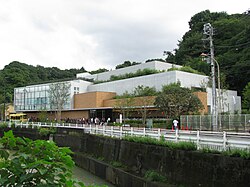
On the second floor the Animal Room greets you with animal figures, and through the Anywhere Door at the back you enter Exhibition Room II. The F Theater shows an original short film on a 200-inch screen that plays nowhere else. On the first floor, the artist's own desk stands in Sensei's Room, ringed by a huge bookcase overhead and the dinosaur figures he loved. The second floor also has a kids' space beside the nursing room.Strollers cannot be used inside, so bring a carrier; a stroller you arrive with is held at the museum's stroller parking. Admission is free for children 3 and under and 500 yen from age 4. The F Theater admits each person once, on a ticket handed to you at entry; showings start at 10:20 and run every 20 minutes, three an hour, so pick a slot early that will not land on nap time. You may not eat or drink in the exhibition rooms, though capped plastic bottles and water bottles may be carried in. Baby food can be given in the museum cafe or in the nursing room. Visitors are not cycled out, so you may stay to the 18:00 close, but there is no re-entry. The cafe gets busy: a family with a third-grader on a Saturday in 2023 waited 90 minutes.

Out on deck there are masts and a great many ropes, and every rope that works the sails is made fast to a rod called a belaying pin. The ship's wheel sits right at the stern, so the helmsman could watch the sails while steering. In the officers' saloon the table and chairs are fixed to the floor, because the ship often heeled at sea.You are asked to hold small children by the hand at all times. On board, do not run except in an emergency, watch your head and your feet, and use the handrail on the stairs. Sandals, geta and high heels are singled out as a slipping risk. Climbing the masts is not allowed.