
Dotonbori
An entertainment street along a canal finished in 1615 and named for its digger.
piggybackjapan.com

Dotonbori
SaveAn entertainment street along a canal finished in 1615 and named for its digger.
What you come to look at is not in the shops but over the street.
MoreWhat kind of place
The street is named after a man.
Yasui Doton spent his own fortune to start digging a canal here in 1612 and was killed in the siege of Osaka before it was finished; his cousin completed it in 1615, and the canal was named Dotonbori so that later generations would know who dug it.
Playhouses moved in around 1626 and stayed — the shopping association compares the cluster to Broadway — and the playwright Chikamatsu Monzaemon, who died in 1724, premiered most of his work here.
Today that same association counts roughly 120 members and about 140 shops. The sign everyone photographs is the sixth Glico runner, put up in October 2014: 20 meters (about 66 feet) tall and burning some 140,000 LEDs.
The founder took the figure from watching children sprint for a finish line.
With kidsThe part that matters
The things you came to see hang over the street rather than sitting in the shops: a crab, a squid, an octopus, even a cow.
Down at eye level, a mechanical doll (Kuidaore Taro) beats a gong and a drum, and for a photo with him there is no ticket and no line.
When the crowd on the street thickens, a ramp built into Ebisubashi bridge takes a stroller down to the riverside promenade one level below, a path built for walking with no vehicles allowed on it.
There is no restroom down there, so getting that done up at street level first saves climbing back for it.
With a stroller the daytime is the safer bet, and the Glico sign is lit only from after sunset until midnight, so a photograph of it means coming back after dark.
Sources and evidence (5)
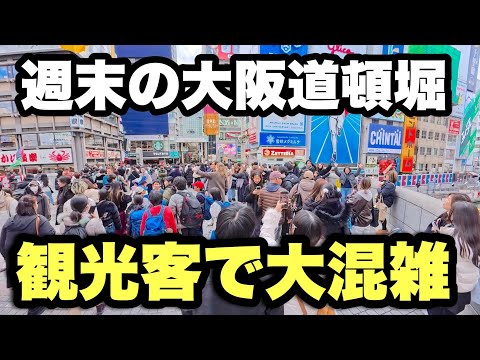
- From a channel that films nothing but how crowded tourist spots are. Watch it before deciding on the stroller.source
- 464 places as of 15 July 2026. None is inside Dotonbori; the nearest are Namba and Shinsaibashi.source
- A reporter tries it with kids. The adult pays from 450 yen per 30 min; two children of elementary age or under go free.source
- One level below the packed street: a walking route across Minami, run by Nankai since 2012.source
- Written by the merchants: lanterns from 1 July, the Myaku-Myaku ceremony on 6 July, bon odori on 8 August.source
By age0-1 / 2-3 / 4-6
- Ages 0-1What you came to see is above the street. Giant three-dimensional signs, a crab, a squid, an octopus, even a cow, hang overhead, so a baby in your arms can look up at them. The Glico sign leaning over the Dotonbori canal is 20.00 m high and 10.38 m wide, built from about 140,000 LED chips, and lights from sunset until midnight. Ebisubashi bridge has a ramp built into its design, so a stroller rolls down to the riverside walk one level below (Tombori River Walk).There is no public nursing room and no diaper changing table inside Dotonbori (it is not among the 464 "Baby Stations" Osaka City listed as of 15 July 2026). The nearest are Namba Station on the Subway Midosuji Line (nursing and diaper change, 5:00-24:00 daily; speak to staff at the stationmaster's office) and Shinsaibashi BIGSTEP (nursing and diaper change, 11:00-20:00, with a formula-water dispenser). The riverside walk has no toilet either, so go before you head down.
- Ages 2-3The street is lined with figures. There is Kuidaore Taro, ringing his bell and beating his drum, and the skewer-shop old man growling "no double-dipping." The Dotonbori merchants' association writes that they "greet you with every kind of expression: Dotonbori is like a theme park of figures." Nothing to queue for. You find them and take the picture.Ebisubashi is where the crowd jams. Osaka City writes that "jumping up and down on the bridge obstructs safe passage and is extremely dangerous." The city also forbids jumping into the Dotonbori canal: the water by Ebisubashi is about 3.5 m deep and heavily used by boats. No official page names a place to report a lost child in this district. In summer the evening events run one after another (the Dotonbori River Mantosai from 1 July, 2,100 lanterns), so with a stroller the daytime is the safer half.
- Ages 4-6They can get on a boat and pass under nine bridges. The Tombori River Cruise runs about 20 minutes, departing on the hour and the half hour from the 11:00 to the 21:00 sailing. The pier is Tazaemonbashi, and the operator says to "look for the oval yellow Ferris wheel (Don Quijote Dotonbori) as your landmark." The merchants' association tells visitors that the Dotonbori canal is "the place where Issun-boshi, the One-Inch Boy, is said to have set off in his rice bowl."The boat is open-topped, with no roof. It "sails in light rain," but umbrellas are refused as dangerous, since they "can jab other passengers or catch on the low bridges," and in rain you are handed a simple raincoat (which the operator notes may not cover your bags). Sailings can be cancelled for weather, sea conditions, or tide. On fares: for children below elementary school age, one rides free per adult, and from the second child on the "child" fare applies (500 yen, the elementary school rate).
By weatherRain, heat, cold
- Rainy dayAll of it is outdoors: public streets plus the Tombori River Walk, which the City of Osaka describes as a waterside promenade along the Dotonbori canal, and the promenade has no roof. The Tombori River Cruise boats are the open type, and in rain you are handed a simple raincoat.
- Hot dayNot checked yet
- Cold dayNot checked yet
How was it with your kids?
Not greatGreat
- ElevatorElevator:not checked
- Stroller OKStroller friendly:with conditionsconditions
- RentalStroller rental:not checked
- NursingNursing space:not checked
- ChangingDiaper changing table:not checked
- Family WCFamily restroom:not checked
- Own foodOutside food allowed:not checked
- EnglishEnglish support:not checked
* Other not checked (7)
Diaper disposal bin, Kids' toilet seat & step stool, Child switch (rider swap), Steps & slope caution, Lost-child support, Official family-friendly certification, Quietness (guide)
Green = we confirmed it. Gray = not checked yet. Gray with a line through = the place does not have it.
Worth a look before you go
 YouTube
Japanese · opens translatedVideo
From a channel that films nothing but how crowded tourist spots are. Watch it before deciding on the stroller.
A Saturday in February filmed in 4K, so you can see how tight the crowd really gets
Japanese · opens translatedOfficial
464 places as of 15 July 2026. None is inside Dotonbori; the nearest are Namba and Shinsaibashi.
Osaka City's own register of places that let you nurse a baby and change a diaper
Japanese · opens translatedGuide
A reporter tries it with kids. The adult pays from 450 yen per 30 min; two children of elementary age or under go free.
An all-weather indoor play room for babies to lower elementary age, inside Dotonbori itself
Japanese · opens translatedOfficial
One level below the packed street: a walking route across Minami, run by Nankai since 2012.
The city's page on the 1 km riverside promenade it built, Minatomachi to Nipponbashi
Japanese · opens translatedOfficial
Written by the merchants: lanterns from 1 July, the Myaku-Myaku ceremony on 6 July, bon odori on 8 August.
The shopping association's own August newsletter: what is on in Dotonbori this summer
Dotonbori · Links & reads ▾
Where to go next
- Jiyuken Namba HontenWestern-style dinerStroller friendly5 min walkOsaka's first Western-style restaurant, opened in Namba in 1910.
- Kuromon MarketFood market streetDiaper changing table10 min walkPufferfish and fruit out front, shop after shop, down one straight street.
- Kids Plaza OsakaChildren's museumStroller friendlyNursing spaceDiaper changing table4.0 kmA children's museum built to be touched, the first of its kind in Japan.
- Hozenji Yokocho5 min walkHozenji Yokocho is two stone-paved lanes lined with about 60 restaurants, beside a small temple.
- Osaka CastleCastleStroller friendlyNursing spaceDiaper changing table3.0 kmA castle keep rebuilt in 1931 by public donation, holding an eight-floor museum inside.
- Umeda Sky Building (Kuchu Teien Observatory)Observation deckStroller friendlyNursing spaceElevator4.2 kmTwo Osaka skyscrapers joined at the top by an open rooftop deck, 173 meters up.


- SHINSAIBASHI-SUJI SHOPPING STREETStroller friendly5 min walkA covered shopping arcade 580 meters long, running north from Dotonbori to Nagahori-dori.
- Universal Studios JapanMovie theme parkStroller friendlyNursing spaceDiaper changing table6.3 kmA film theme park on Osaka Bay, its ten areas including Mario and Harry Potter worlds.
- Osaka Municipal Nagai Botanical GardenBotanical gardenStroller friendlyNursing spaceDiaper changing table6.9 kmRoses, hydrangeas, peonies: eleven collections in a botanical garden inside Nagai Park.
- Osaka Aquarium KaiyukanAquariumStroller friendlyNursing spaceDiaper changing table6.8 kmAn aquarium arranged by region around the Pacific Rim, holding some 620 species.


- Kids Plaza OsakaChildren's museumStroller friendlyNursing spaceDiaper changing table4.0 kmA children's museum built to be touched, the first of its kind in Japan.
- Hozenji Yokocho5 min walkHozenji Yokocho is two stone-paved lanes lined with about 60 restaurants, beside a small temple.
- Osaka CastleCastleStroller friendlyNursing spaceDiaper changing table3.0 kmA castle keep rebuilt in 1931 by public donation, holding an eight-floor museum inside.
- Umeda Sky Building (Kuchu Teien Observatory)Observation deckStroller friendlyNursing spaceElevator4.2 kmTwo Osaka skyscrapers joined at the top by an open rooftop deck, 173 meters up.
- Osaka Municipal Nagai Botanical GardenBotanical gardenStroller friendlyNursing spaceDiaper changing table6.9 kmRoses, hydrangeas, peonies: eleven collections in a botanical garden inside Nagai Park.
- Osaka Aquarium KaiyukanAquariumStroller friendlyNursing spaceDiaper changing table6.8 kmAn aquarium arranged by region around the Pacific Rim, holding some 620 species.
Where it is
Before you go
- The street's name is a man's name. Yasui Doton spent his own fortune to begin digging the south canal here in 1612, and was killed in the summer siege of Osaka before it was finished. His cousin Doboku took the work over on the orders of the lord of Osaka Castle, Matsudaira Tadaaki, and the canal was completed in 1615. It was named Dotonbori so that later generations would know who dug it. A monument to the two men stands at the east side of the north end of Nipponbashi bridge, restored in 2014, a hundred years after it went up.source
- It has been a theater town for four centuries. Playhouses moved into Dotonbori around 1626, kabuki, joruri chanting and sideshow booths lined the south bank, and five licensed theaters raised their towers over the district. Chikamatsu Monzaemon (1653-1724) left more than 30 kabuki scripts and over 100 puppet plays, most of them premiered here at houses such as the Takemoto-za, and the shopping association writes that the theaters clustered here rather as Broadway does, and that a Dotonbori stage was what any performer with ambition wanted. Today puppet theater sits at the National Bunraku Theatre and variety shows at the Kadoza and Namba Grand Kagetsu, while the kabuki house (Osaka Shochikuza) is listed by its own operator as closed — so the association's line about kabuki at the Shochikuza does not hold at the moment.source
More notes (11)
- The signs themselves are the destination, and the shopping association says so in its own words. The giant signs are what people picture even if they have never been here, above all the Glico man with his arms flung wide, leaning out over the canal, remade in the fall of 2014 as the sixth version in LED. Crab, squid, octopus and even a cow are built out in three dimensions overhead, which the association calls a symbol of the street's energy.source
- The Glico sign has stood in some form since 1935. Ezaki Glico gives the numbers for the current one, installed in October 2014 as the sixth generation with the logo at the top redesigned in June 2022: 20 meters (about 66 feet) tall by 10.38 meters (about 34 feet) wide, roughly 140,000 LED chips, lit from after sunset until midnight, with a note that the hours may be cut short depending on conditions. A release dated June 24, 2022 announced that the company's purpose had been added above the running figure and the sign relit 30 minutes after sunset. The running man himself came from founder Riichi Ezaki watching children sprint for a finish line and taking it as an image of healthy growth.source
- Dolls do the greeting here, as the association tells it. Kuidaore Taro, banging his gong and drum, is the one everyone wants a photograph with; the skewered-cutlet shop's old man growling that you must not double-dip is another. The faces run from angry to cheerful and everything in between, so that the street works nearly as a theme park of dolls — and the association's invitation is simply to come with a camera.source
- Ebisubashi bridge, in Osaka City's construction bureau figures, is 26 meters (85 feet) long and 11 to 18 meters (36 to 59 feet) wide, a girder bridge completed in fiscal 2007, with the bridge section finished in November 2007. The city explains the design as a circular plaza on the bridge to give it the feel of a stage, with ramps set along the plaza so that people can walk down toward the water and watch the view change as they go. The bridge it replaced dated from 1925 and had aged out, so it was rebuilt alongside the canal waterfront project; because the old bridge was familiar to visitors as well as to shoppers on Shinsaibashi-suji, the city ran a design competition at home and abroad and built the winning entry.source
- One step below street level there is a path made for walking, which Osaka City describes as a waterside promenade along the Dotonbori canal, built to put people close to the water and make the city more appealing. The city designated the roughly 1-kilometer (0.6-mile) stretch from Minatomachi to Nipponbashi as an eased-regulation zone in April 2012, and from that same month Nankai Electric Railway, chosen by open call, has handled both drawing people there and maintaining it; the operator dates the promenade itself to December 2004. Events held on it must leave a pedestrian lane of about 2 meters (6 feet), because it is a public promenade, and no vehicles may be brought in. The promenade has no restroom at all — asked directly, the operator answers that there is none and to use a public restroom nearby — and no water supply and no parking.source
- The river cruise (Tonbori River Cruise, run by Ipponmatsu Kaiun) lasts about 20 minutes from the Tazaemonbashi landing, running down to Nipponbashi, turning, out to Minatomachi Riverplace, turning again and coming back, passing under nine bridges. Departures are on the hour and the half hour from 11 a.m. through 9 p.m. You board beside the river-side entrance of the Don Quijote store on the north bank of the promenade; the official directions say to look for the yellow oval Ferris wheel there. The boats are open-topped, so simple rain ponchos are handed out when it rains, though they may not cover your bags, and umbrellas are turned away as dangerous — they can jab other passengers or catch on the low bridges. It sails in light rain but can be canceled for weather, sea conditions or water level. Fares are 2,000 yen for adults, 1,000 yen for students with ID and 500 yen for elementary school children; one child under school age rides free per adult, and the child fare starts from the second one.source
- Osaka City posts its own warning against jumping into the Dotonbori canal or bouncing about on Ebisubashi and the other bridges, and it gives the reasons. The water near Ebisubashi is about 3.5 meters (11 feet) deep and falls below 10 degrees Celsius (50 Fahrenheit) in winter, boats pass constantly, and past jumps have caused injuries and deaths. Jumping about on a bridge, it adds, blocks people trying to get across and is dangerous in itself.source
- On cigarettes: Osaka City widened its street smoking ban to cover the entire city on January 27, 2025, heated tobacco included, with a 1,000-yen fine for breaking it. Smoking is confined to city-designated smoking areas and to the smoking spots that restaurants and commercial buildings set up. That is the rule as written, which is a different thing from a guarantee that it is being followed.source
- There is an old story on the water. The shopping association writes that this is where Issun-boshi, the one-inch boy, is said to have set off riding in a rice bowl, and that an event was once held on the canal in which people raced in bowls of their own making, to wish for the recovery of the Hozenji Yokocho alley. Stand by the canal in the breeze and remember the old tale, the association suggests, rather than only the neon.source
- On crowds, the shopping association's June 2026 newsletter says visitor numbers were trending somewhat lower in April, but that a great many people came in May and the street has been busy every day. The same issue reports that the summer canal lantern festival began on July 1 with 2,100 lanterns offered this year, past last year's 2,025, and that an international Bon dance was set for August 8, 2026 — dancing together with visitors from abroad, as the association put it. The newsletter does not say where the dance is held.source
- For scale and routes: the shopping association gives its founding as around 1955, roughly 120 members and about 140 shops, with its office in the basement of the Nakaza Kuidaore building at 1-7-21 Dotonbori, Chuo Ward. From Namba Station on the subway's Midosuji, Yotsubashi and Sennichimae lines, and from Osaka Namba on the Hanshin and Kintetsu lines, it is right outside exit 14; from Nippombashi Station on the Sakaisuji and Sennichimae lines, right outside exit 2; from Nankai Namba, about a 7-minute walk north from the north exit. From Kansai Airport the Nankai Rapi:t reaches Nankai Namba in about 35 minutes, and the limousine bus reaches the OCAT terminal in Namba in about 50.source
Basics
- Fee:Walking Dotonbori costs nothing. It is a public street plus a riverside promenade, and Osaka Convention & Tourism Bureau's page for the Tombori River Walk gives the charge as free. Its page for Dotonbori itself has no fee row at all — opening hours and closing days are both given as varying by shop, because the street has no single price. What costs money is what you choose inside it. The Tombori River Cruise, about twenty minutes from the pier by the Don Quijote store, is 2,000 yen for an adult, 1,000 yen for a student — junior high, high school, university or vocational college, on showing a student card — and 500 yen for an elementary-school child. Below elementary-school age, one child per adult goes free, and the child rate applies from the second onesource23
- Hours:No official page gives Dotonbori an opening or closing time; it is a public street and a promenade. Osaka Convention & Tourism Bureau fills in both its opening-hours and closing-days rows with the same phrase — it varies by shop. What does keep hours are the things in the street. Ezaki Glico gives the sign's lighting as sunset to 24:00, adding that the lighting may be shortened depending on circumstances. The river cruise leaves on the hour and the half hour from the 11:00 boat to the 21:00 boat, runs in light rain, and can be canceled for weather, sea conditions or tide. The Tombori River Walk quotes 10:00-22:00 as the window for holding an event, but says in the same breath that the hours differ with the place and the kind of event, and that amplified sound stops at 20:00; events cannot be held at all from 30 December to 3 January. The promenade has no toilets of its own — the operator asks you to use public ones nearbysource23456
- Booking:Dotonbori is a public street plus a riverside promenade that Osaka City built and Nankai Electric Railway has run since April 2012. No official page gives it a gate, a ticket or a reception desk, and none of them mentions booking for the street itself — booking appears only on the things inside it. For the Tombori River Cruise, fax booking is for parties of ten or more; parties of ten or fewer can book some sailings on the web with payment in advance. Bookings open three months ahead and can be changed or canceled up to 17:00 the day before. You can also just turn up — tickets are issued on the day only. Individual restaurants set their own rulessource23Official booking site ↗
- Note: there is no public nursing room or changing table inside Dotonbori itself. Osaka City's register of Baby Stations — 464 places as of 15 July 2026 — lists none here. The nearest are Namba station on the Midosuji subway line (nursing and changing, every day 05:00-24:00; ask at the stationmaster's office) and Shinsaibashi BIGSTEP (nursing and changing, 11:00-20:00, with a bottle warmer)source23
Basics in detail (6)
- Note that there is no public nursing room or changing table inside Dotonbori itself, and none of the 464 baby stations Osaka City listed as of July 15, 2026 is here; the closest are Namba Station on the Midosuji subway line (nursing and changing, daily 5 a.m. to midnight, asking a staff member at the stationmaster's office) and the Shinsaibashi BIGSTEP building (nursing and changing, 11 a.m. to 8 p.m., with a water heater for formula).source
- No official source gives an opening or closing time for Dotonbori itself, since it is a public street and a promenade, and the Osaka tourism bureau's page puts both hours and closing days as varying by shop. The times belong to things inside it. Ezaki Glico states that the Glico sign is lit from after sunset until midnight, and notes that the hours may be shortened depending on conditions. The river cruise leaves on the hour and half hour from 11 a.m. through 9 p.m., sailing in light rain but liable to cancellation for weather, sea conditions or water level. The riverside promenade shows 10 a.m. to 10 p.m. for event use, though the same box adds that hours differ by location and by event and that sound equipment must stop at 8 p.m., so it is not a fixed frame; the available dates are every day except December 30 through January 3. The promenade itself has no restroom, and the operator points people to public restrooms nearby.source
- Walking Dotonbori costs nothing. This is a public street and a waterside promenade that the tourism bureau's page lists as free; the page for Dotonbori itself carries no fee field at all and gives hours and closing days as varying by shop, there being no charge common to the whole street. You pay only for what you choose inside it — the river cruise, for instance, about 20 minutes from the Tazaemonbashi landing on the canal side of the Don Quijote store, at 2,000 yen for adults, 1,000 yen for students from junior high through college or vocational school with student ID, and 500 yen for elementary school children. One child below school age rides free per adult, and the child fare applies from the second one on.source
- Dotonbori is a public street plus the waterside promenade that Osaka City built and Nankai Electric Railway has operated since April 2012. No official page shows anything that works as an entrance, a ticket or a reception desk, nor says anything about booking the street itself. Reservations come up only for what is inside it: the river cruise takes fax bookings for parties of 10 or more, offers online booking with advance payment for some smaller groups, accepts bookings from three months out, and allows changes and cancellations until 5 p.m. the day before. You can also simply show up and ride, since tickets are issued on the day only. The shops each set their own rules.source
- The Dotonbori canal lantern festival is on for 2026, and the shopping association reports that this year's offering came to 2,100 lanterns, past last year's 2,025, lighting up the street's evenings.source
- Eighty support lanterns for the Dotonbori Expo 2026 summer festival are hung in front of the main branch of the crab restaurant (Kani Doraku), lit from 7 p.m. to 10 p.m.source
Once you've decided
evidence & sources (4)
- tonbori.jp: Stroller friendly, Indoor / outdoor, Stroller access notes
- Public agency: Stroller friendly, Stroller access notes
- Official: Stroller access notes
- Official: Crowding (guide)
- Public agency: Stroller access notes
- Public agency: Crowding (guide)
- ipponmatsu.co.jp: Indoor / outdoor
- tonbori.jp: Stroller friendly
- Official: main site
This entertainment district in southern Osaka is a public street along a canal, and its draw hangs overhead. Crab, squid, octopus and cow are modeled at giant scale over the street, and the Glico running man has faced the water since 1935. A doll called Kuidaore Taro rings a bell and beats a drum; the merchants call their street a theme park of dolls. One level below, a riverside promenade runs about a kilometer, reached by the slope built into Ebisubashi.
| Stroller friendly | Yes | You can push a stroller: this is a public street with no gate and no ticket. Ebisubashi was rebuilt in November 2007, and Osaka City describes the design as a circular bridge-top plaza that expresses theatricality, with a slope taken in along the plaza so that you can enjoy the scenery shifting as you go down to the water. That slope is how wheels get from the street to the promenade one level below. Osaka City and Nankai both call the lower level a promenade, and its operator refuses vehicle load-in even for paid events and requires about 2 m of walking width to be left clear. What no official page maps is which of the other bridges give you only steps down — the operator's rules bar event use of 'the stairs and the slopes', which tells you the walk has both but not where, so plan to come and go by Ebisubashi. Nothing official states whether the street has stroller parking or left-luggage | Web-checked | checked Aug ’26 | city.osaka.lg.jpcity.osaka.lg.jptonbori.jptonbori.jp |
|---|---|---|---|---|---|
| Diaper changing table | Not checked yet | No public changing table is listed anywhere in Dotonbori: Osaka City's Baby Station register (464 places, 15 July 2026) has no entry here. See the note in the basics for the nearest ones | |||
| Nursing space | Not checked yet | Same as the changing table: nothing public inside Dotonbori appears in Osaka City's Baby Station register (15 July 2026). See the note in the basics | |||
| Indoor / outdoor | Outdoor | Outdoors throughout. Dotonbori is a public street and the Tombori River Walk, which Osaka City describes as a waterside promenade along the Dotonbori River. The promenade has no roof and no toilets of its own; the operator asks you to use public ones nearby. The river cruise is an open boat — in rain the crew hand out simple raincoats, and umbrellas are refused because they can hit other people and catch on the low bridges | Web-checked | checked Aug ’26 | city.osaka.lg.jptonbori.jpipponmatsu.co.jp |
| Family restroom | Not checked yet | No official page covers toilets for the street as a whole. The operator of the riverside promenade does say the promenade itself has none and asks you to use public toilets nearby | |||
| Diaper disposal bin | Not checked yet | Not stated on any official page (as of 11 August 2026); there is no single operator of the street to state it | |||
| English support | Not checked yet | Not stated. The shopping association publishes its site in Japanese, English, Chinese and Korean, but nothing official describes English support on the street itself | |||
| Outside food allowed | Not checked yet | Not stated. On a public street there is no one to permit or refuse it; each shop sets its own rule. Note that smoking is a different matter — Osaka City has banned it on every street in the city | |||
| Kids' toilet seat & step stool | Not checked yet | Not stated on any official page (as of 11 August 2026) | |||
| Elevator | Not checked yet | Not stated. Getting between the street and the riverside promenade is described only in terms of stairs and slopes; no official page mentions an elevator | |||
| Stroller rental | Not checked yet | Not stated. The street has no operator's counter to lend from | |||
| Child switch (rider swap) | Not checked yet | Not stated (as of 11 August 2026). No one runs the street as a whole, so no one sets a rider-swap rule for it; the boats and rides inside it are run by their own operators | |||
| Steps & slope caution | Not checked yet | No official document maps the steps and slopes of the district as a whole. Two sourced pieces: Ebisubashi has a slope built in that takes you down to the water, and the promenade's operator lists 'the stairs and the slopes' among the places an event may not occupy — so the walk has both, though no page says where | |||
| Crowding (guide)Extra info — guide only | Yes | There is no crowding chart, but three official statements point the same way. The shopping association's newsletter for June 2026 says April visitor numbers were slightly down and that from May the street has been busy every day. Osaka City warns that jumping about on the bridges obstructs safe passage and is very dangerous, which tells you Ebisubashi is a place where the flow jams. And the summer fills the riverside: the lantern festival from 1 July with 2,100 lanterns, and the bon odori on 8 August. Daytime is the safer bet with a stroller | Web-checked | checked Aug ’26 | dotonbori.or.jpcity.osaka.lg.jpdotonbori.or.jp |
| Stroller access notesExtra info — guide only | Yes | Three things to settle before you set off. First, the exit: Namba station on the Midosuji, Yotsubashi and Sennichimae subway lines, and Osaka-Namba on the Hanshin and Kintetsu lines, put you at Dotonbori from exit 14; from Nipponbashi station on the Sakaisuji and Sennichimae lines it is exit 2; from Nankai Namba it is a walk of about seven minutes north from the north entrance. Second, the level: the crowded shopping street is at ground level and a 1 km riverside promenade runs one level below it, reached by the slope built into Ebisubashi — but the promenade has no toilets, so go before you go down. Third, smoking: since 27 January 2025 Osaka City has banned smoking, heated tobacco included, on every street in the city, and breaking the rule makes you liable to a 1,000 yen fine. Legal smoking is confined to the city's designated spots and to smoking areas provided by shops and restaurants | Web-checked | checked Aug ’26 | dotonbori.or.jpcity.osaka.lg.jpcity.osaka.lg.jptonbori.jpcity.osaka.lg.jp |
| Lost-child supportExtra info — guide only | Not checked yet | Not stated. There is no single information desk for the street; the shopping association's office is a business office, not a visitor counter | |||
| Official family-friendly certificationExtra info — guide only | Not checked yet | No family-friendly certification from a public body or third party was found for the district | |||
| Quietness (guide)Extra info — guide only | Not checked yet |