Asakusa with a toddler (2–3) 3 spots
Asakusa is the temple town of Sensoji, the oldest temple in Tokyo. One straight, flat lane of shops runs from the Kaminarimon gate, easy to cover with a stroller. It suits families who want short walks and street food.
A small amusement park, a flower garden in 1853, that calls itself Japan's oldest.
Nursing room · Changing table · Elevator · checked Aug ’26
Tokyo's oldest temple, approached through a stone-paved shopping street from the great gate.
Stroller OK · Changing table · Elevator · checked Aug ’26
Asakusa Imahan Kokusai Street Head Restaurant
A sukiyaki and shabu-shabu house in Asakusa since 1895, serving only female black wagyu.
Elevator · checked Oct ’26
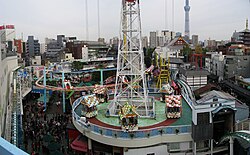
At age 2, Pyon Pyon, the Helicopter, Bikkuri House, Carnival, the Maruhana Swordsmanship Dojo and Scoop Cameraman open up, and together with the merry-go-round and Chibikko Taxi that already take 0-year-olds, the list of choices suddenly widens. Seventeen attractions plus festival stalls and eateries are packed into a small site, so the next ride is a few steps away.Nin Nin Park requires a same-day numbered ticket and an accompanying adult aged 20 or over (one adult may take up to three children); it is free from 6 months to 2 years and charged from age 3. Pyon Pyon needs an accompanying adult aged 16 or over. Ride fees start at age 5, so most rides cost nothing for this age (the exceptions are the Roller Coaster, Disk'O and Little Star, which are charged even under 5 once the child meets the height rule). Adults riding along do pay, except on the Helicopter and Shirasagi, where the accompanying adult rides free.
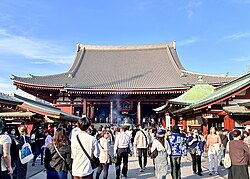
One thing after another is big enough to read with the eye. The giant straw sandal on Hozomon is 4.5 m tall, 1.5 m wide and 500 kg, made from 2,500 kg of straw and offered by supporters from Murayama in Yamagata; the story goes that demons take fright at whoever must wear such a sandal to guard this temple and leave. The five-storey pagoda stands 53 m from the ground. Along Nakamise, about 250 m and some 90 shops from Kaminarimon to Hozomon, some stalls make their sweets in front of you, so ningyo-yaki and hand-grilled rice crackers can be eaten fresh off the iron.In the inner sanctuary of the main hall you take off your shoes and step up onto tatami. Nakamise is paved in stone. In front of the main hall stands the great incense burner, where a steady stream of worshippers draw the rising smoke over themselves and pray for health. Entry to the grounds is free, and the main hall is open 6:00 to 17:00 (opening at 6:30 from October to March, closing at the same hour). Some 30 million visits are made here a year, so if you would rather have fewer people, come after sunset: the buildings are lit, the Nakamise shops close and the Asakusa picture scroll painted on their shutters comes out, and Taito City's tourism section writes that it is quieter than daytime and easier to walk at your own pace.

On the raised tatami seats you take your shoes off, so a child who wants out of a chair can simply stay on the tatami. Lunch runs 11:30-14:30 and is built around rice bowls: the "Hyakunen Gyudon" at 2,200 yen (limited to 20 servings a day) and the "Meiji Sukiyaki Don" at 3,300 yen.There are only three raised tatami tables on the 1st floor, seating up to four each. Reservations are not taken for the lunch menu, and lunch seating can close early depending on crowding and the number of seats. From 14:30 to 16:00 seating is suspended for the time being while the restaurant prepares for dinner. A 10% service charge applies once one person's bill reaches 5,500 yen.