Asakusa with preschoolers (4–6) 3 spots
Asakusa is the temple town of Sensoji, the oldest temple in Tokyo. One straight, flat lane of shops runs from the Kaminarimon gate, easy to cover with a stroller. It suits families who want short walks and street food.
A small amusement park, a flower garden in 1853, that calls itself Japan's oldest.
Nursing room · Changing table · Elevator · checked Aug ’26
Tokyo's oldest temple, approached through a stone-paved shopping street from the great gate.
Stroller OK · Changing table · Elevator · checked Aug ’26
Asakusa Imahan Kokusai Street Head Restaurant
A sukiyaki and shabu-shabu house in Asakusa since 1895, serving only female black wagyu.
Elevator · checked Oct ’26
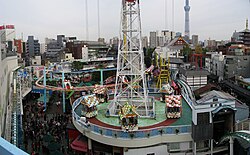
Once a child clears 90 cm they can ride Shirasagi, and at 110 cm the roller coaster that has been running since 1953, the oldest surviving one in Japan. Beyond the seventeen attractions there are festival stalls too, so a child this age can choose their own route. Watching the stage shows costs nothing beyond admission, and photography is allowed.Four rides have a height rule: Shirasagi from 90 cm, the Roller Coaster from 110 cm, Disk'O from 120 cm and Little Star from 130 cm. A child below the line cannot ride even with an adult, so measuring beforehand saves an argument on the day. On Shirasagi, a child under 120 cm needs an accompanying junior-high student or older. Ride fees begin at age 5, and the One Day Pass with admission and unlimited rides is 3,400 yen for children aged 5 through elementary school. You can re-enter: tell the staff at the exit and they will give you a re-entry ticket. Packed lunches are allowed, at the tables and benches in the park.
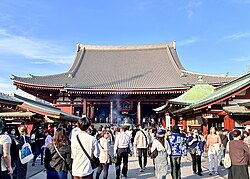
A child this age can draw their own fortune slip. Senso-ji's are the Kannon Hyakusen, and the rule is always to return the stick to the tube it came from. Even a bad fortune is fine: the temple writes that there is nothing to fear, and that living honestly and with patience turns it to good, after which you tie it at the appointed spot in the grounds to keep the connection. Kaminarimon is guarded left and right by the gods of wind and thunder, which is why its formal name is Furaijinmon, and on the back of the gate stand the water-ruling dragon deities Tenryu in male form at 2.93 m and Kinryu in female form at 2.74 m, symmetrically placed, so there are four statues to count, two at the front and two behind.Taito City's tourism section suggests bathing in the smoke of the great incense burner to purify yourself before you pray. In the inner sanctuary you take off your shoes and step onto tatami. The fortune stick always goes back in its tube. For a break, the 6th floor multipurpose space of the Taito City Asakusa Culture Tourist Information Center directly in front of Kaminarimon has chairs on a stepped floor and allows eating, packed lunches included (it may be unavailable when an event is on). On 9 and 10 July, the Shimanrokusennichi and hozuki market fill the grounds with about 100 lantern-plant stalls and worshippers from morning to night.

The 1st floor has three chair tables seating up to six, so once a child can eat sitting in a chair, a family of six fits at one table. The sukiyaki uses Senju negi, called "the scallion among scallions," and shiitake thick enough to stand up to the warishita broth. The beef is only female black wagyu, selected from across Japan.Parties including a child under junior-high age are seated on the 1st floor. Guests are asked to arrive by 19:00, and the latest reservation start time is also 19:00. A 10% service charge applies from 5,500 yen per person, and ordering from the grand menu adds a beef tsukudani starter at 440 yen per person (tax included).