
Senso-ji
Tokyo's oldest temple, approached through a stone-paved shopping street from the great gate.
piggybackjapan.com


Senso-ji
SaveTokyo's oldest temple, approached through a stone-paved shopping street from the great gate.
The lantern in this temple's gate hides a dragon underneath.
MoreWhat kind of place
Senso-ji is the oldest temple in Tokyo, dated to 628, when two brothers out fishing pulled a statue of Kannon from the river now called the Sumida.
However often they cast their net, only the statue came up, never a fish, and the next morning children of the village enshrined it in a hall they made of grass.
Nearly fourteen centuries later the temple draws about 30 million worshippers a year. The great gate out front is far younger: the gate that stood there burned in 1865, and the site waited 95 years for a new one.
Konosuke Matsushita, head of Matsushita Electric, paid for that one himself in 1960, in thanks after the temple's abbot prayed for him and his joint pain cleared up.
With kidsThe part that matters
A lantern 3.9 meters (13 feet) tall hangs in the great gate, and if your child stands under it and looks straight up, there is a dragon carved on the underside.
Past the gate, a stone-paved lane of about 90 shops runs 250 meters (820 feet) to the inner gate, and some of them make their sweets where you can watch, so a child can eat one fresh off the griddle.
For a feeding, the Asakusa Culture Tourist Information Center across from the great gate has two nursing spaces on its second floor, each with a door you can close and a water heater for formula, open 9 a.m. to 8 p.m.; there is none in the grounds themselves.
The main hall has steps at the front, so the way up without them is the elevator on the west side, to the left as you face the hall.
The hall opens at 6 a.m., and the city says there are fewer people after dark, when the shop shutters come down and the Asakusa scenes painted across them show, so a late walk can go at your child's pace.
Sources and evidence (5)
- The city's own area guide, so you can see what else is within walking distance before you go.source
- It states the no-eating-while-walking rule, which decides where you actually sit down with a child.source
- The grounds and Nakamise have no roof; this is the list of places nearby that do.source
- Opened 23 May 2026 — older stroller-route guides for this station are now out of date.source
- One page for the whole year, so you can see if your dates land on a festival — or a crowd.source
By age0-1 / 2-3 / 4-6
- Ages 0-1Much of what there is to see is overhead. The great lantern at Kaminarimon is 3.9 m tall, 3.3 m wide and 700 kg, and standing directly beneath it you can see the dragon carved into its base. The outer hall of the main hall rises about 10 m to a ceiling carrying three large paintings, Kawabata Ryushi's Dragon at the centre and Domoto Insho's Heavenly Beings and Scattering Flowers on either side, which the temple asks visitors to look up at, and a baby in your arms reaches them just by looking up.There is no nursing room in the temple grounds. The nearest is the 2nd floor of the Taito City Asakusa Culture Tourist Information Center, directly in front of Kaminarimon, with two nursing spaces you can close the door on, a formula water dispenser and a diaper changing bed (9:00-20:00). Inside the grounds, diaper changing sheets are in the two multipurpose toilets, to the right of Hozomon and at the back behind the main hall, each also fitted with wheelchair handrails and a baby chair. No strollers are lent in the grounds; the same Center lends five at the 1F information counter (from 1 month to 4 years, up to 18 kg, 9:00-19:30). The grounds are largely flat, and the temple says it is flat and that work on removing steps continues, but the main hall has stairs at the front, so head around to the lift on the left as you face it, the west side.
- Ages 2-3One thing after another is big enough to read with the eye. The giant straw sandal on Hozomon is 4.5 m tall, 1.5 m wide and 500 kg, made from 2,500 kg of straw and offered by supporters from Murayama in Yamagata; the story goes that demons take fright at whoever must wear such a sandal to guard this temple and leave. The five-storey pagoda stands 53 m from the ground. Along Nakamise, about 250 m and some 90 shops from Kaminarimon to Hozomon, some stalls make their sweets in front of you, so ningyo-yaki and hand-grilled rice crackers can be eaten fresh off the iron.In the inner sanctuary of the main hall you take off your shoes and step up onto tatami. Nakamise is paved in stone. In front of the main hall stands the great incense burner, where a steady stream of worshippers draw the rising smoke over themselves and pray for health. Entry to the grounds is free, and the main hall is open 6:00 to 17:00 (opening at 6:30 from October to March, closing at the same hour). Some 30 million visits are made here a year, so if you would rather have fewer people, come after sunset: the buildings are lit, the Nakamise shops close and the Asakusa picture scroll painted on their shutters comes out, and Taito City's tourism section writes that it is quieter than daytime and easier to walk at your own pace.
- Ages 4-6A child this age can draw their own fortune slip. Senso-ji's are the Kannon Hyakusen, and the rule is always to return the stick to the tube it came from. Even a bad fortune is fine: the temple writes that there is nothing to fear, and that living honestly and with patience turns it to good, after which you tie it at the appointed spot in the grounds to keep the connection. Kaminarimon is guarded left and right by the gods of wind and thunder, which is why its formal name is Furaijinmon, and on the back of the gate stand the water-ruling dragon deities Tenryu in male form at 2.93 m and Kinryu in female form at 2.74 m, symmetrically placed, so there are four statues to count, two at the front and two behind.Taito City's tourism section suggests bathing in the smoke of the great incense burner to purify yourself before you pray. In the inner sanctuary you take off your shoes and step onto tatami. The fortune stick always goes back in its tube. For a break, the 6th floor multipurpose space of the Taito City Asakusa Culture Tourist Information Center directly in front of Kaminarimon has chairs on a stepped floor and allows eating, packed lunches included (it may be unavailable when an event is on). On 9 and 10 July, the Shimanrokusennichi and hozuki market fill the grounds with about 100 lantern-plant stalls and worshippers from morning to night.
By weatherRain, heat, cold
- Rainy dayThe sights run from Kaminarimon gate along about 250 meters of stone-paved approach, the Nakamise, to the temple grounds beyond. Inside the main hall, the outer sanctuary rises about 10 meters to a ceiling with three large paintings.
- Hot dayNot checked yet
- Cold dayNot checked yet
How was it with your kids?
Not greatGreat
- ElevatorElevator:with conditionsconditions
- Stroller OKStroller friendly:with conditionsconditions
- RentalStroller rental:not checked
- NursingNursing space:none
- ChangingDiaper changing table:with conditionsconditions
- Family WCFamily restroom:with conditionsconditions
- Own foodOutside food allowed:not checked
- EnglishEnglish support:not checked
* Other not checked (8)
Hot water for formula, Diaper disposal bin, Kids' toilet seat & step stool, Child switch (rider swap), Steps & slope caution, Indoor / outdoor, Official family-friendly certification, Lost-child support
Green = we confirmed it. Gray = not checked yet. Gray with a line through = the place does not have it.
Worth a look before you go
Japanese · opens translatedOfficial
The city's own area guide, so you can see what else is within walking distance before you go.
Tokyo's own guide to Asakusa: how Kaminarimon, Nakamise and the temple string together
Japanese · opens translatedOfficial
It states the no-eating-while-walking rule, which decides where you actually sit down with a child.
Asakusa street food in 19 shops — and the rule that you may not eat while walking
Japanese · opens translatedGuide
The grounds and Nakamise have no roof; this is the list of places nearby that do.
Eight indoor places in Asakusa for a rainy day
Japanese · opens translatedGuide
Opened 23 May 2026 — older stroller-route guides for this station are now out of date.
New elevators at Asakusa station: Ginza Line to Asakusa Line, and up to street level
Japanese · opens translatedOfficial
One page for the whole year, so you can see if your dates land on a festival — or a crowd.
Asakusa's year: the tourism association's calendar of festivals and temple rites for 2026
Senso-ji · Links & reads ▾
Where to go next
- Asakusa HanayashikiAmusement parkNursing spaceDiaper changing tableElevator5 min walkA small amusement park, a flower garden in 1853, that calls itself Japan's oldest.
- Asakusa Imahan Kokusai Street Head RestaurantSukiyaki & shabu-shabuStroller friendlyElevator5 min walkA sukiyaki and shabu-shabu house in Asakusa since 1895, serving only female black wagyu.
- Solamachi Tabe-Terrace Food CourtFood courtStroller friendlyNursing spaceDiaper changing table15 min walkA food court at the foot of Skytree: udon, ramen and rice bowls at one table.
- National Museum of Nature and ScienceScience museumStroller friendlyNursing spaceDiaper changing table1.9 kmA national museum shown at full size — dinosaur skeletons, a life-size blue whale.
- Tokyo SkytreeObservation towerStroller friendlyNursing spaceDiaper changing table1.4 kmAt 634 meters, the tallest free-standing broadcast tower in the world.
- Tokyo National MuseumNational museumStroller friendlyNursing spaceDiaper changing table1.9 kmJapan's oldest museum, six buildings on one site, showing almost only real objects.
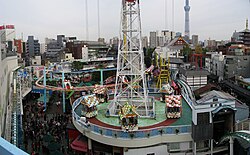


- Ueno Seiyoken HontenWestern restaurantNursing spaceDiaper changing tableElevator2.2 kmWestern food in a corner of Ueno Park, from a restaurant founded in 1872.
- National Museum of Nature and ScienceScience museumStroller friendlyNursing spaceDiaper changing table1.9 kmA national museum shown at full size — dinosaur skeletons, a life-size blue whale.
- Tokyo SkytreeObservation towerStroller friendlyNursing spaceDiaper changing table1.4 kmAt 634 meters, the tallest free-standing broadcast tower in the world.

- Ueno ParkCity parkStroller friendlyNursing spaceDiaper changing table2.3 kmOne of Japan's first public parks, with the zoo and museums inside its grounds.
- Sumida AquariumAquariumStroller friendlyNursing spaceElevator15 min walkAn aquarium at the foot of Tokyo Skytree, built so you get close to the animals.
- Ueno ZooZooStroller friendlyNursing spaceDiaper changing table2.3 kmJapan's first zoo, with about 300 species spread over two gardens.
- Ameyoko Shopping StreetMarket streetStroller friendlyDiaper changing table2.1 kmA market street of some 400 shops packed into 500 meters between two stations.


- Asakusa Imahan Kokusai Street Head RestaurantSukiyaki & shabu-shabuStroller friendlyElevator5 min walkA sukiyaki and shabu-shabu house in Asakusa since 1895, serving only female black wagyu.
- Solamachi Tabe-Terrace Food CourtFood courtStroller friendlyNursing spaceDiaper changing table15 min walkA food court at the foot of Skytree: udon, ramen and rice bowls at one table.
- Ueno Seiyoken HontenWestern restaurantNursing spaceDiaper changing tableElevator2.2 kmWestern food in a corner of Ueno Park, from a restaurant founded in 1872.
- National Museum of Nature and ScienceScience museumStroller friendlyNursing spaceDiaper changing table1.9 kmA national museum shown at full size — dinosaur skeletons, a life-size blue whale.
- Tokyo SkytreeObservation towerStroller friendlyNursing spaceDiaper changing table1.4 kmAt 634 meters, the tallest free-standing broadcast tower in the world.
- Tokyo National MuseumNational museumStroller friendlyNursing spaceDiaper changing table1.9 kmJapan's oldest museum, six buildings on one site, showing almost only real objects.
- Sumida AquariumAquariumStroller friendlyNursing spaceElevator15 min walkAn aquarium at the foot of Tokyo Skytree, built so you get close to the animals.
- Ueno ZooZooStroller friendlyNursing spaceDiaper changing table2.3 kmJapan's first zoo, with about 300 species spread over two gardens.
- Asakusa HanayashikiAmusement parkNursing spaceDiaper changing tableElevator5 min walkA small amusement park, a flower garden in 1853, that calls itself Japan's oldest.
- Ueno ParkCity parkStroller friendlyNursing spaceDiaper changing table2.3 kmOne of Japan's first public parks, with the zoo and museums inside its grounds.
Piggyback Japan guides
- One Day in Asakusa with Small Children
A temple and an amusement park a few minutes apart. There is no nursing room inside the temple grounds — here is where the nearest one is, and why 0–4s get into the park free.
Where it is
2-3-1 Asakusa, Taito-ku, Tokyo 111-0032source
Before you go
- The lantern in the great gate is 3.9 meters (13 feet) tall, 3.3 meters (11 feet) wide and weighs 700 kilograms (about 1,540 pounds), with a dragon carved into its underside. The gods of wind and thunder guard the two sides, which is why the gate's formal name is Furaijinmon, and on the back face stand the water-ruling dragon deities, Tenryu in male form at 2.93 meters (9 ft 7 in) and Kinryu in female form at 2.74 meters (9 ft), set symmetrically against them.source
- The gate you see today went up in 1960, ninety-five years after fire destroyed the previous one in 1865, paid for personally by Konosuke Matsushita, president of Matsushita Electric, who donated it in thanks after the temple's abbot prayed to the principal image and his joint pain cleared up.source
- The shopping street called Nakamise runs about 250 meters (820 feet) from the great gate to the inner gate, vermilion-painted shops lining both sides of the approach, and it counts among the oldest shopping streets in Japan. It began around 1685, when shopkeepers were allowed to trade here in exchange for cleaning the temple grounds, and toys, sweets and souvenirs were the mainstay from the start.source
More notes (23)
- The pair of straw sandals on the inner gate stand 4.5 meters (15 feet) tall and 1.5 meters (5 feet) wide, weigh 500 kilograms (1,100 pounds) and took 2,500 kilograms (5,500 pounds) of straw, offered by a group of volunteers from Murayama in Yamagata Prefecture, and the story goes that evil spirits take one look, wonder what manner of being guards this temple, and leave. The lantern on the same gate is 3.75 meters (12 feet) tall, 2.7 meters (9 feet) wide and weighs 450 kilograms (990 pounds).source
- The outer chamber of the main hall opens about 10 meters (33 feet) up to a ceiling carrying three large paintings, a dragon by Kawabata Ryushi in the center with heavenly beings and scattering blossoms by Domoto Insho on either side, and the temple asks visitors to look up and take them in. Worshippers in the Edo period seem to have prayed to those heavenly beings too, since a comic verse survives joking that the figures have grown tired of hearing everybody's wishes.source
- A lantern 4.5 meters (15 feet) across hangs from the canopy that juts out over the steps up to the main hall.source
- The temple's principal image is a statue of the Sacred Kannon that came up in a fishing net early on March 18 in the year 628, when the brothers Hinokuma no Hamanari and Takenari were working the Miyato River, today the Sumida. The story says that however often they cast, the statue came up and the fish did not, and the next morning children of the village enshrined it in a hall they made of grass, which puts nearly 1,400 years behind the place.source
- The temple's mountain name, Kinryuzan, meaning golden dragon mountain, comes from its founding record: on the day Kannon appeared, some thousand pines sprang up overnight, and three days later a dragon with golden scales came down from the sky into that pine grove. The Golden Dragon Dance is still performed here as a temple dance.source
- The five-story pagoda reaches 53 meters (174 feet) above the ground, the tower itself measuring 48.32 meters (159 feet), and its top level holds Buddha relics received in 1966 from the Isurumuniya temple in Sri Lanka. From outside it looks as though it rises straight from the ground, but it actually stands on top of a building that serves as its base.source
- The fortune slips here are the old Kannon hundred-slip set, and while people often say Senso-ji hands out a lot of bad fortunes, the temple explains that these are simply the fortunes as they have always been, and that anyone drawing a bad one turns it to good by living patiently and honestly rather than fearing it. A bad slip gets tied at the spot set aside for it in the grounds, and the numbered stick always goes back in its tube.source
- A large incense burner stands in front of the main hall, and a steady stream of worshippers pull the rising smoke over themselves and pray to stay free of illness.source
- The temple counts around 30 million visits a year.source
- Senso-ji is the thirteenth stop on the Bando pilgrimage of thirty-three Kannon temples and the first on the Edo equivalent, and the Bando thirteenth is the only one of that circuit inside Tokyo. The seal-stamp office is at Yogodo hall on the west side of the grounds.source
- The principal image is a hidden one and cannot be seen on an ordinary visit, and only its stand-in statue is revealed, once a year, at the opening ceremony held at 2 p.m. on December 13.source
- The name is read Senso-ji, not Asakusa-dera, and the temple explains that temple names in Japan are customarily read with the Chinese-derived pronunciations.source
- Founded in 628, Senso-ji is held to be the oldest temple in Tokyo, and as the Asakusa Kannon it drew the devotion of ordinary townspeople and became a center of Edo culture.source
- The incense burner in front of the main hall is said to drive off bad energy, and the Taito City tourism office suggests bathing in the smoke to purify yourself before you pray.source
- Northwest of the main hall stands a small single-story wooden hexagonal hall, thought to date from the Muromachi period, holding a Jizo who is said to grant a wish if you pray for a set number of days. It is the oldest wooden building in Tokyo and a designated tangible cultural property of the metropolis.source
- After sunset the buildings are lit and the vermilion stands out more sharply, and with the roughly 90 shops of Nakamise closed for the night you can look at the Asakusa scenes painted across their shutters. The Taito City tourism office writes that there are fewer people than in the daytime, so you can take the walk slowly.source
- Nakamise counts about 90 shops along the 250-meter (820-foot) stone-paved approach from the great gate to the inner gate, matching lit signs above them and decoration that changes with the season, selling souvenirs and food. Local sweets such as ningyo-yaki cakes, hand-grilled rice crackers, dango, deep-fried manju and kaminari-okoshi are the specialty, and some shops make them where you can watch, so you eat them fresh off the griddle.source
- The paintings on the Nakamise shutters were made under the supervision of a professor from the Tokyo University of the Arts, as a way of using the shutters once the shops close, and the Asakusa scenes on them, the Golden Dragon Dance among them, give the street an Edo feel at night.source
- Nitenmon gate is a nationally designated Important Cultural Property, and Yogodo hall enshrines Daikokuten, one of the Seven Lucky Gods of the Asakusa circuit.source
- July 10 is the temple's greatest day of merit, said to be worth 46,000 days of it, which is where the name Shimanrokusennichi comes from. 46,000 days works out to roughly 126 years, about as long as a person could possibly live, so the day is described as earning a lifetime of merit at once. Explanations of the number vary, one being that a sho measure of rice holds 46,000 grains and that the word for one sho sounds like the word for one lifetime. In the Edo period people crowded in from the 9th to be first, which is how both the 9th and the 10th became fair days.source
- Behind the ground cherry market lies an old popular belief that swallowing a ground cherry whole with water would cut the cramping pains of an adult and rid a child of belly trouble, which people of the time blamed on worms inside the stomach.source
- The thunder-warding charm has its own history: red corn was once sold on the day of 46,000 days as a protection against lightning, but a poor harvest around the beginning of the Meiji era took it off the market, and when worried believers asked for something to take its place the temple began handing out a triangular tag held in a split bamboo stick.source
- The temple's own English pages state that Senso-ji is the oldest temple in Tokyo and that this important center of religious faith draws 30 million worshippers every year.source
Basics
- Fee:Two of Tokyo's own official sources say the grounds cost nothing: the metropolitan accessibility guide gives the fee for Senso-ji as "keidai jiyu", meaning the precinct is freely open, and GO TOKYO, the city's official tourism site, tags the temple's page "free to enjoy". The temple's own website carries no statement about an admission fee either way, and Taito City's spot page has no fee field at allsource23
- Hours:The main hall is open 6:00-17:00; from October to March it opens at 6:30 instead, closing at the same time. Opening times for the other halls are not published — the temple asks you to phone. For the grounds themselves, Tokyo's accessibility guide gives "freely open" under both opening hours and closing days. The temple's own site gives no closing dayssource23
- Note: there is no nursing room inside the temple grounds. The nearest is on the second floor of the Taito City-run Asakusa Culture Tourist Information Center, directly opposite Kaminarimon gate — open 9:00-20:00, with two nursing spaces whose doors close, a formula-water heater and a changing bedsource2
Basics in detail (12)
- There is no nursing room in the temple grounds, and the nearest one is on the second floor of Taito City's Asakusa Culture Tourist Information Center directly in front of the great gate, open 9 a.m. to 8 p.m., with two nursing spaces you can close the door on, a water heater for making formula and a diaper changing bed.source
- The main hall is open 6 a.m. to 5 p.m., opening at 6:30 a.m. from October through March with the same closing time, while the hours of the other halls are not published and the temple asks you to call and ask. The grounds themselves are listed by the Tokyo metropolitan guide as open with no set hours and no closed days, and no closing days appear anywhere on Senso-ji's own site.source
- Walking the grounds costs nothing, and both of Tokyo's official sources agree on that: the Bureau of Industrial and Labor Affairs barrier-free tourism guide gives the fee as free access to the grounds, and the metropolitan tourism site GO TOKYO tags the Senso-ji page as somewhere you can enjoy for free. Senso-ji's own site says nothing about an admission fee either way, and Taito City's tourism page has no fee field at all.source
- The service marking the appearance of the principal image on March 18 in the year 628 fills the day: the Golden Dragon Dance is performed on the west side of the grounds, the abbot and the priests of the temple walk in procession from Denbo-in through Nakamise to the main hall, and the service itself begins at 2 p.m.source
- The White Heron Dance is performed in the temple grounds.source
- The Treasure Dance is performed in the temple grounds.source
- For the 46,000-day fair and the ground cherry market, about 100 stalls selling ground cherries fill the grounds and worshippers pack the place from morning until night, with wind chimes on sale too. July 10 is the temple's greatest day of merit, reckoned at 46,000 days of it, and the thunder-warding charm is given out on these two days only.source
- The chrysanthemum memorial service and the Golden Dragon Dance take place at the main hall.source
- The blessing service for children of three, five and seven is held at the main hall.source
- The hagoita market, stall after stall of decorated wooden battledore paddles, fills the grounds alongside the last Kannon fair day of the year on December 18.source
- The New Year's Eve bell is rung at Bentenyama.source
- A service is held at the main hall on the monthly fair day of the principal image, and on the first of every month at 10 a.m. there is a sutra-turning service, which on New Year's Day alone starts at 8 a.m.source
Once you've decided
evidence & sources (7)
- Public agency: Stroller friendly, Diaper changing table, Family restroom
- Official: Stroller friendly, Diaper changing table, Family restroom
- Public agency: Stroller friendly, Elevator
- Public agency: Family restroom, Nursing space
- Official: Stroller friendly, Elevator
- Public agency: Crowding (guide)
- Public agency: Stroller friendly
- Public agency: Stroller access notes
- Public agency: Stroller access notes
- gotokyo.org: Nursing space
- Official: Crowding (guide)
- Official: main site
The oldest temple in Tokyo stands at the end of a shopping street where shops make their sweets in the window. A great lantern hangs in Kaminarimon, the outer gate, with a dragon carved into its underside. At the inner gate hang straw sandals so large that demons are said to take fright and leave. In front of the main hall, people pull the smoke from an incense burner over themselves for health.
| Stroller friendly | Yes | The grounds are mostly level. Tokyo's accessibility guide says the paths through the precinct are wide enough to move around easily, Taito City writes that the grounds are flat with hardly any steps, and the temple itself says the grounds are level and that it is working on removing the steps that remain — the temple's own wording leaves that as work in progress. All three describe wheelchair access: nothing official was found about strollers themselves, about where to leave one, or about rental. The main hall has steps at the front, and the elevator is round on its left (west) side. The inner sanctuary is entered with your shoes off, stepping up onto tatami. Nakamise, the shopping approach, is laid with flagstones | Web-checked | checked Aug ’26 | sangyo-rodo1.metro.tokyo.lg.jpsenso-ji.jpt-navi.city.taito.lg.jpsenso-ji.jpt-navi.city.taito.lg.jp |
|---|---|---|---|---|---|
| Diaper changing table | Yes (2) | Both of the two accessible restrooms in the grounds — one to the right of Hozomon gate, one behind the main hall — have a changing mat. Whether other restrooms in the grounds have one is not published. Tokyo's accessibility guide separately lists three wheelchair-accessible restrooms with changing mats, near Bentenyama, near Sensoji Hospital and the Mokubakan public restroom on Okuyama Omairimachi; these are not added to the count, because it is not clear whether they are the same restrooms under other names | Web-checked | checked Aug ’26 | senso-ji.jpsangyo-rodo1.metro.tokyo.lg.jp |
| Family restroom | Yes (2) | Two accessible restrooms in the grounds — one to the right of Hozomon gate, one behind the main hall — each with grab rails, a changing mat and a baby seat. The temple states that these have no ostomate fittings. Tokyo's accessibility guide names different restrooms, near Bentenyama, near Sensoji Hospital and the Mokubakan public restroom, and says the Mokubakan one does have ostomate fittings. Separately, the Asakusa Culture Tourist Information Center opposite Kaminarimon has accessible restrooms on floors 1, 4 and 7, the first-floor one being wheelchair-priority with a care bed and ostomate fittings | Web-checked | checked Aug ’26 | senso-ji.jpsangyo-rodo1.metro.tokyo.lg.jpcity.taito.lg.jp |
| Elevator | Yes | There is an elevator on the left (west) side of the main hall as you face it. The temple describes it as being for people who have difficulty with stairs, and Tokyo and Taito City name the same place — the hall faces south, so "left as you face it" and "west side" agree. The front of the main hall has steps, so you go round to that side | Web-checked | checked Aug ’26 | senso-ji.jpsangyo-rodo1.metro.tokyo.lg.jpt-navi.city.taito.lg.jpsenso-ji.jp |
| Crowding (guide)Extra info — guide only | Yes | Taito City writes that after sunset, once the buildings are lit and the Nakamise shops have closed, there are fewer people than in the daytime and you can walk round at your own pace. The temple itself publishes a figure of around 30 million visits a year — that is the temple's own number, not a crowding grade | Web-checked | checked Aug ’26 | t-navi.city.taito.lg.jpsenso-ji.jp |
| Stroller access notesExtra info — guide only | Yes | There is no stroller rental in the temple grounds. The Taito City-run Asakusa Culture Tourist Information Center, directly opposite Kaminarimon, lends them from the information counter on its first floor — five strollers, for children from one month to four years old and up to 18 kg, 9:00-19:30. It runs through a rental service, so membership, how to book and the price are handled on that service's own site. On the sixth floor of the same building, a stepped multi-purpose space with seating is open as a rest area where you may eat food you have brought; groups apply in advance, and it can be unavailable when an event is on | Web-checked | checked Aug ’26 | city.taito.lg.jpcity.taito.lg.jp |
| Nursing space | No | Tokyo's official accessibility guide, surveyed in January 2026, marks Senso-ji with the pictogram for no nursing space. Note that another official Tokyo source disagrees: the GO TOKYO tourism site lists a nursing room among the temple's facilities. Either way, the sure thing is across the road — the Taito City-run Asakusa Culture Tourist Information Center, directly opposite Kaminarimon, has two nursing spaces with doors on its second floor, 9:00-20:00 | Web-checked | checked Aug ’26 | sangyo-rodo1.metro.tokyo.lg.jpgotokyo.orgcity.taito.lg.jp |
| Hot water for formula | Not checked yet | ||||
| Stroller rental | Not checked yet | ||||
| Outside food allowed | Not checked yet | ||||
| English support | Not checked yet | ||||
| Diaper disposal bin | Not checked yet | ||||
| Kids' toilet seat & step stool | Not checked yet | ||||
| Child switch (rider swap) | Not checked yet | ||||
| Steps & slope caution | Not checked yet | ||||
| Indoor / outdoor | Not checked yet | ||||
| Official family-friendly certificationExtra info — guide only | Not checked yet | ||||
| Lost-child supportExtra info — guide only | Not checked yet |