
Tokyo National Museum
Japan's oldest museum, six buildings on one site, showing almost only real objects.
piggybackjapan.com


Tokyo National Museum
SaveJapan's oldest museum, six buildings on one site, showing almost only real objects.
A hands-on corner in the archaeology room lets children ring a replica bronze bell.
MoreWhat kind of place
Japan's oldest museum began as an exhibition held in 1872. It holds about 120,000 objects, including 90 National Treasures, and shows more than 3,000 of them at any one time across its six buildings.
Paintings, textiles, and lacquerware are swapped out every four to eight weeks, so the rooms are never quite the same twice.
Sources and evidence (21)
- The Tokyo National Museum, called Tohaku for short in Japanese, traces its start to an exhibition held in 1872 in the main hall of the Yushima Seido, which makes it the museum with the longest history in Japan.source
- The collection runs to about 120,000 items, among them 90 National Treasures and 652 Important Cultural Properties as of April 2026.source
- The regular collection galleries keep more than 3,000 works on display at any one time.source
- There are six exhibition buildings in all: Honkan (the Japanese Gallery), Toyokan (the Asian Gallery), Heiseikan, the Gallery of Horyuji Treasures, the Kuroda Memorial Hall, and Hyokeikan.source
- The museum states that nearly everything on display is an original object, and that the few reproductions were made only after study and research.source
- Honkan opened in 1938 and was designated an Important Cultural Property in 2001; a concrete building under a tiled roof, it is the leading example of the Imperial Crown style, and its architect, Watanabe Jin, also designed the Wako building in Ginza.source
- The entrance hall of Honkan opens up through two floors around a marble staircase, which the museum calls a magnificent sight and says you may recognize from a commercial or a television drama.source
- The second floor of Honkan follows Japanese art in order from the Jomon period to the Edo period, tracing a history of art told through original masterpieces, National Treasures and Important Cultural Properties among them.source
- Hyokeikan opened in 1909 and was designated an Important Cultural Property in 1978; two lions stand at its entrance, the one on the right with its mouth open and the one on the left with its mouth closed, together forming the sounds a and un.source
- The Black Gate can be seen up close from 10:00 a.m. to 4:00 p.m. on weekends and public holidays, weather permitting. It was the front gate of the Edo residence of the Ikeda family, lords of the Tottori domain, built at the end of the Edo period and designated an Important Cultural Property in 1951.source
- Toyokan opened in 1968 to a design by Taniguchi Yoshiro, and its interior is unusual: an open well that you climb in a spiral from the basement to the fifth floor, taking the exhibition rooms one after another.source
- The Gallery of Horyuji Treasures opened in 1999, and its bright exterior surrounded by greenery with an artificial pool, along with its hushed exhibition rooms, is the work of Taniguchi Yoshio, the architect of the Museum of Modern Art in New York.source
- The Gallery of Horyuji Treasures holds and shows more than 300 treasures presented by Horyuji temple to the imperial family in 1878 and transferred to the state after the war, and what marks the collection out is how many date from the 7th century, a generation older than the Shosoin treasures.source
- The former storehouse of Jurin-in is a small log-built storehouse one bay square, made in the Kamakura period, moved here in 1882 and designated an Important Cultural Property in 1953.source
- The garden spreading out north of Honkan sets five teahouses around a pond, is colored by flowers through the seasons and by autumn leaves, and still holds unusual trees and wild plants left over from the museum's former natural history department.source
- The garden keeps a bronze five-story pagoda 5.7 meters tall, presented to Horyuji temple by Tokugawa Tsunayoshi, the fifth shogun, with a dragon coiled around the spire at its very top.source
- The Tokyo National Museum was built on land that had been the grounds of Kaneiji temple, and the garden too was once part of the temple.source
- Toyokan is built on the idea of a journey through the art of Asia, showing art, craft, and archaeological finds from China, the Korean peninsula, Southeast Asia, Central Asia, India, Egypt, and elsewhere.source
- Paintings, calligraphy, textiles, and lacquerware are changed over every four to eight weeks, so the works on show are different each time you come.source
- The Tokyo National Museum stands inside Ueno Park.source
- Ueno Park was one of the first places in Japan designated a park, under an 1873 government decree that also covered Shiba, Asakusa, Fukagawa, and Asukayama, and its main plantings are ginkgo, camphor, zelkova, about 1,200 cherry trees, and lotus.source
With kidsThe part that matters
Six exhibition buildings stand on this one site, and the museum's own answer is that an hour is the minimum and a proper look takes more than a day, so with small children start in the archaeology room on the first floor of Heiseikan.
That is the room the museum itself recommends for children, and they can ring a replica of an ancient bronze bell there with their own hands.
The same floor has the family space for preschoolers and their adults, two nursing rooms, a diaper changing area with a diaper vending machine at the entrance, and a lounge where you can eat the food you brought, so a break does not mean leaving the museum.
When they have had enough, ask the staff at the main gate exit to stamp your ticket, and you can spend the rest of the day in Ueno Park and still come back in.
Sources and evidence (10)
- Room C on the first floor of Honkan is a hands-on room where you can try things from Japanese culture yourself instead of only looking at them.source
- The archaeology room on the first floor of Heiseikan has a hands-on corner where you can actually ring a replica bronze bell.source
- The hands-on corner in room 9 on the first floor of Honkan lets you spin 3D images of the artworks on a screen, but it works only when volunteers are on duty.source
- A rest corner in room 6 on the third floor of Toyokan lets you try out some of the fortune-telling practices of Asian countries.source
- The museum publishes two free downloads for younger children: a welcome leaflet written for preschoolers and an exploring map to follow as you go around.source
- A special exhibition for families is held every year, and as part of an animal-themed program run together with Ueno Zoo and the National Museum of Nature and Science, it takes up subjects to do with animals.source
- Where children stop: design a maki-e pattern on a touchscreen, ring the bronze bell replica. Two buildings is a day out.source
- The Heiseikan lounge has vending machines, tables and chairs for a packed lunch. Eat at 11; noon to 2:30 is full.source
- Two Ueno museums in one day: eat first, then look; take three of the six buildings; lunch before the crowd, curry ¥850.source
- In winter Honkan Room 5 turns into a play space in one-hour slots: a Fuji-shaped slide, a ball pool, replicas to touch.source
By age0-1 / 2-3 / 4-6
- Ages 0-1Anyone under 18 sees the TNM Collection for free. Strollers can be used on the grounds and inside the exhibition rooms as well, and every building has elevators or ramps. The Family Space on Heiseikan 1F is a room for preschool children, mainly 0 to 6, to spend time in together with a guardian.There are two private nursing rooms in the Family Space on Heiseikan 1F, usable any time during opening hours without a reservation; just tell the Information counter. Diaper changing sheets are in the restrooms of the Main Gate Plaza, Honkan, Heiseikan, Toyokan, and the Gallery of Horyuji Treasures, and the diaper changing area on Heiseikan 1F also has a changing table for older children and a vending machine selling disposable diapers. Strollers are lent at the Honkan Information counter, recommended up to age 2 and limited in number, and when the museum is crowded they may ask you not to use one inside the exhibition rooms, for children's safety.
- Ages 2-3In the archaeology room on Heiseikan 1F, the Archaeology Hands-On corner lets a child actually ring a replica bronze bell (dotaku). Room C on Honkan 1F is "The Plaza of Japanese Culture", a hands-on exhibition space, and the stairwell next to Rooms B and C on the same floor holds a calm-down space that you may enter freely when it is empty.The Family Space cannot be used by children alone or adults alone. Only drinks in fully closable containers may be taken in; food is eaten in the Heiseikan 1F lounge. Indoors, eating and drinking is allowed in four places, the Heiseikan 1F lounge, the Honkan B1F lounge, the lounge beside the front entrance of the Research and Information Center 1F, and the covered terrace on Toyokan 3F, while outdoors is free. You can re-enter on the same day: tell the staff at the Main Gate exit and they stamp the date on your ticket.
- Ages 4-6The museum gives away a welcome leaflet for preschoolers, "Welcome to the Museum!", and an "Exploration Map" for walking the galleries; print them and bring them along. In Room 9 on Honkan 1F, the Midori-no-Lion hands-on corner has "Spin the TNM", where you turn 3D images of the objects any way you like, and Room 11 opens with the flame-shaped Jomon pot every textbook shows, followed by clay figurines, a Yayoi bronze bell, and Kofun-period haniwa.The hands-on activities in the Midori-no-Lion corner run only while a volunteer is in the room. Free entry for under-18s is checked at the door, so bring something showing the child's age, such as a health insurance card. The museum publishes a crowding table by day and by hour: Honkan is marked "crowded" for every slot from 10:30 to 14:30 on Sundays and public holidays, while the Gallery of Horyuji Treasures is marked "uncrowded" on every day and at every hour. From 26 October 2026 to 26 April 2027, Honkan Room 4, the room used for the Parent and Child Gallery, is closed for facility work.
By weatherRain, heat, cold
- Rainy dayThe collection is shown inside six separate buildings: Honkan, Toyokan, Heiseikan, the Gallery of Horyuji Treasures, the Kuroda Memorial Hall, and Hyokeikan. What's outdoors is the garden and the Kuromon gate, and the gate's weekend and holiday opening (10:00 to 16:00) can be called off depending on the weather.
- Hot dayNot checked yet
- Cold dayNot checked yet
Time needed1 h
How was it with your kids?
Not greatGreat
- ElevatorElevator:with conditionsconditions
- Stroller OKStroller friendly:with conditionsconditions
- RentalStroller rental:with conditionsconditions
- NursingNursing space:with conditionsconditions
- ChangingDiaper changing table:with conditionsconditions
- Family WCFamily restroom:with conditionsconditions
- Own foodOutside food allowed:with conditionsconditions
- EnglishEnglish support:with conditionsconditions
* Other not checked (6)
Diaper disposal bin, Kids' toilet seat & step stool, Child switch (rider swap), Official family-friendly certification, Quietness (guide), Lost-child support
Green = we confirmed it. Gray = not checked yet. Gray with a line through = the place does not have it.
Worth a look before you go
Guide
Where children stop: design a maki-e pattern on a touchscreen, ring the bronze bell replica. Two buildings is a day out.
Tokyo National Museum: Free & Hands-On for Kids
Japanese · opens translatedGuide
The Heiseikan lounge has vending machines, tables and chairs for a packed lunch. Eat at 11; noon to 2:30 is full.
Going with children? Bring your own lunch to the Tokyo National Museum
Japanese · opens translatedFirst-hand
Two Ueno museums in one day: eat first, then look; take three of the six buildings; lunch before the crowd, curry ¥850.
A summer day in Ueno with a schoolchild: two museums, and five ways not to wear out
Japanese · opens translatedFirst-hand
In winter Honkan Room 5 turns into a play space in one-hour slots: a Fuji-shaped slide, a ball pool, replicas to touch.
With a 4-year-old and a baby to the museum's limited-run play space, Asobiba Tohaku
Tokyo National Museum · Links & reads ▾
Where to go next
- National Museum of Nature and ScienceScience museumStroller friendlyNursing spaceDiaper changing table5 min walkA national museum shown at full size — dinosaur skeletons, a life-size blue whale.
- Ueno ParkCity parkStroller friendlyNursing spaceDiaper changing table10 min walkOne of Japan's first public parks, with the zoo and museums inside its grounds.
- Ueno ZooZooStroller friendlyNursing spaceDiaper changing table5 min walkJapan's first zoo, with about 300 species spread over two gardens.
- Ameyoko Shopping StreetMarket streetStroller friendlyDiaper changing table10 min walkA market street of some 400 shops packed into 500 meters between two stations.
- Asakusa Imahan Kokusai Street Head RestaurantSukiyaki & shabu-shabuElevator1.6 kmA sukiyaki and shabu-shabu house in Asakusa since 1895, serving only female black wagyu.
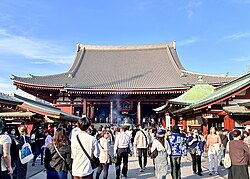
- Senso-jiTempleStroller friendlyDiaper changing tableElevator1.9 kmTokyo's oldest temple, approached through a stone-paved shopping street from the great gate.


- Ueno Seiyoken HontenWestern restaurantNursing spaceDiaper changing tableElevator5 min walkWestern food in a corner of Ueno Park, from a restaurant founded in 1872.
- Asakusa Imahan Kokusai Street Head RestaurantSukiyaki & shabu-shabuElevator1.6 kmA sukiyaki and shabu-shabu house in Asakusa since 1895, serving only female black wagyu.
- Senso-jiTempleStroller friendlyDiaper changing tableElevator1.9 kmTokyo's oldest temple, approached through a stone-paved shopping street from the great gate.

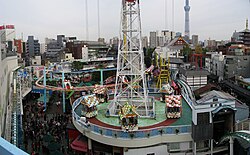
- Asakusa HanayashikiAmusement parkNursing spaceDiaper changing tableElevator1.8 kmA small amusement park, a flower garden in 1853, that calls itself Japan's oldest.
- ASOBono!Indoor playgroundStroller friendlyNursing spaceDiaper changing table2.5 kmAn indoor playground at Tokyo Dome City, its ball pool filled with some 40,000 balls.
- Ameyoko Shopping StreetMarket streetStroller friendlyDiaper changing table10 min walkA market street of some 400 shops packed into 500 meters between two stations.

- Ueno Seiyoken HontenWestern restaurantNursing spaceDiaper changing tableElevator5 min walkWestern food in a corner of Ueno Park, from a restaurant founded in 1872.
- Asakusa Imahan Kokusai Street Head RestaurantSukiyaki & shabu-shabuElevator1.6 kmA sukiyaki and shabu-shabu house in Asakusa since 1895, serving only female black wagyu.
- National Museum of Nature and ScienceScience museumStroller friendlyNursing spaceDiaper changing table5 min walkA national museum shown at full size — dinosaur skeletons, a life-size blue whale.
- Ueno ZooZooStroller friendlyNursing spaceDiaper changing table5 min walkJapan's first zoo, with about 300 species spread over two gardens.
- Senso-jiTempleStroller friendlyDiaper changing tableElevator1.9 kmTokyo's oldest temple, approached through a stone-paved shopping street from the great gate.
- Ueno ParkCity parkStroller friendlyNursing spaceDiaper changing table10 min walkOne of Japan's first public parks, with the zoo and museums inside its grounds.
- Asakusa HanayashikiAmusement parkNursing spaceDiaper changing tableElevator1.8 kmA small amusement park, a flower garden in 1853, that calls itself Japan's oldest.
- ASOBono!Indoor playgroundStroller friendlyNursing spaceDiaper changing table2.5 kmAn indoor playground at Tokyo Dome City, its ball pool filled with some 40,000 balls.
Where it is
Before you go
- Strollers can be used on the grounds and inside the exhibition rooms as well, though when it is crowded staff may ask you not to use one indoors, for children's safety.source
- You can borrow a stroller at the information counter in Honkan; the museum says they suit children up to age two and that numbers are limited.source
- The first floor of Heiseikan has a family space where preschool children, roughly ages 0 to 6, can spend time with a parent or guardian; children on their own and adults on their own cannot use it.source
- Since Saturday, August 1, 2026, suitcases and wheeled cases have not been allowed inside the buildings, to protect the works on display and keep viewing safe and comfortable.source
- The museum publishes a downloadable page of the rules for looking at the exhibits, written for children who can read.source
More notes (26)
- From Monday, November 30 through Thursday, December 31, 2026, rooms 17 to 20 in Honkan and all of Toyokan are shut while the display environment is improved.source
- From Monday, October 26, 2026 through Monday, April 26, 2027, room 4 in Honkan, the room used for the yearly exhibition for parents and children, is shut while the display environment is improved.source
- The museum warns that the ticket window at the main gate can mean a wait of more than 30 minutes when it is busy, and recommends buying online instead.source
- Electronic tickets for the regular collection galleries are not tied to a date or a time slot, and stay valid for two months from purchase.source
- There is no group booking system for the regular collection galleries.source
- The ticket window at the main gate takes credit cards (Visa, Mastercard, JCB, American Express, Diners Club, Discover), electronic money (iD, transit IC cards such as Suica, and WAON), and UnionPay.source
- You can leave and come back in on the same day by asking the staff at the main gate exit to stamp the date on your ticket.source
- The museum warns that the route from Uguisudani Station has stretches of narrow sidewalk and steeply sloped curb cuts.source
- The museum warns that Ueno and Nezu stations on the Tokyo Metro and Keisei Ueno Station are 800 to 1,200 meters away, with steep slopes and level changes on the way.source
- There is no public parking lot and no bicycle parking; the free spaces reserved for visitors with disabilities are few, so call 03-3822-1111 before you come.source
- Honkan and Hyokeikan have steep ramps at their entrances, and small steps of one to two centimeters inside.source
- The garden is reached by the path in front of the restaurant in the Toyokan annex, but a wheelchair cannot go inside the teahouses there, including the one housing the Tohaku Chakan tearoom.source
- The nursing rooms can be used any time the museum is open, no booking needed; just speak to someone at an information counter.source
- A childcare room in the Main Gate Plaza offers paid childcare, booked in advance and limited in numbers, though you can use it without a booking if a place is open on the day.source
- Childcare runs only on set days, in August 2026 the 1st, 9th, 15th, 23rd, and 30th, and you book by calling Asuka Co., Ltd. at 0120-165-115 on weekdays between 10:00 a.m. and 5:00 p.m.source
- Indoors, eating and drinking is allowed in four places only: the lounge on the first floor of Heiseikan, the lounge in the Honkan basement, the lounge beside the front entrance of the Research and Information Center, and the covered terrace on the third floor of Toyokan.source
- Even in indoor spaces where eating and drinking is not allowed, certain areas let you drink from a container with a lid.source
- The Restaurant Tokyo National Museum and the Garden Cafe, on the first floor of the Toyokan annex, are announced to open on Friday, August 28, and had not opened yet when this was checked on August 12, 2026.source
- Okuno, a sushi kaiseki restaurant on the first floor of the Gallery of Horyuji Treasures, is due to open on Wednesday, September 30, and the museum notes the date may change.source
- In the regular collection galleries you may take photos and video for personal use only, works marked with a no-photography sign cannot be photographed, and the special exhibition halls are as a rule off limits for photography.source
- Monopods, tripods, selfie sticks, and flash cannot be used when taking photos.source
- The museum publishes a crowding chart by building, by day of the week, and by the hour, marking each slot as quiet, fairly quiet, or crowded.source
- On that chart, Honkan is marked crowded for every hour from 10:30 a.m. to 2:30 p.m. on Sundays and public holidays.source
- On that chart, the Gallery of Horyuji Treasures is marked quiet in every time slot, from Tuesday through Sunday and on public holidays.source
- On that chart, Honkan is marked quiet at 3:30 p.m. on Tuesday, Wednesday, Thursday, and Friday alike.source
- Ueno Park is a metropolitan park of 538,506.96 square meters that opened on October 19, 1873, and it is open from 5:00 a.m. to 11:00 p.m., with no entry outside those hours.source
Basics
- Fee:The museum's own collection galleries cost 1,000 yen for adults and 500 yen for university students. Everyone through high school, anyone under 18, and anyone 70 or over gets in free — show something that proves the age, such as a student card, health insurance card or driving license. A visitor with a disability and one carer each go free on showing the certificate. Special exhibitions are priced separately, but a special exhibition ticket also lets you into the collection galleries the same day. Three days in 2026 are free for everyone: 19 May (International Museum Day), 21 September (Respect for the Aged Day) and 3 November (Culture Day).source
- Hours:9:30 to 17:00, with the last entry 30 minutes before closing. On Fridays and Saturdays — and on a Sunday when the Monday after it is a public holiday — the museum stays open until 20:00. Closed Mondays; when a Monday is a public holiday it opens and closes the next weekday instead. The year-end closure runs 26 to 31 December 2026, reopening on 1 January 2027 (opening hours for that day not yet announced). The garden is open 9:30 to 17:00. Two things to check before you go. Hyokeikan only opens for special exhibitions and events. And two closures are already announced: Honkan rooms 17-20 and the whole of Toyokan are shut from 30 November to 31 December 2026, and Honkan room 4 — the room used for the family exhibition 'Parent and Child Gallery' — is shut from 26 October 2026 to 26 April 2027.source23
- Time to allow:1 hsource
- Booking:There is no timed entry to book. The e-ticket for the museum's own collection galleries carries no date or time slot, and stays valid for two months from purchase, so you can buy it before the trip and decide the day later. There is no group booking scheme for the collection galleries at all. What the museum does warn about is the queue at the gate: when it is busy, buying a ticket at the Main Gate window can take more than 30 minutes, and it recommends buying online instead. The window takes credit cards, transport IC cards and other e-money, and UnionPay. You can leave and come back the same day — ask the staff at the Main Gate exit to date-stamp your ticket.source2Official site ↗
- Note: since 1 August 2026 suitcases and wheeled cases cannot be brought into the buildings — each gallery has lockers, and the information counter takes what will not fit. Also, as of 12 August 2026 the restaurant, the cafe and the sushi place have all yet to open (THE RESTAURANT Tokyo National Museum and Garden Cafe are announced for Friday 28 August; the sushi kaiseki Okuno for Wednesday 30 September). Until then, food on site means the SHOP STOP food truck in front of Honkan, the Ueshima Coffee branch at the Kuroda Memorial Hall, and TOHAKU Chaka in the garden teahouse.source23
Basics in detail (22)
- Open 9:30 a.m. to 5:00 p.m., and until 8:00 p.m. on Fridays and Saturdays. A Sunday also stays open until 8:00 p.m. if the Monday after it is a public holiday.source
- Last admission is 30 minutes before closing.source
- The museum is closed on Mondays, but when a Monday is a public holiday it opens and closes the next weekday instead.source
- It closes for the year end from Saturday, December 26 through Thursday, December 31, 2026, and reopens on Friday, January 1, 2027, a public holiday, with the hours for that day not yet decided.source
- In the 2026 fiscal year it stays open on Monday April 27, Monday August 10, Monday September 21, and Monday March 29, 2027, and closes for special reasons on Tuesday April 7 and Tuesday December 15.source
- The Kuroda Memorial Hall is open 9:30 a.m. to 5:00 p.m. all year, with last admission at 4:30 p.m.source
- Hyokeikan opens only when a special exhibition or an event is running, and is closed the rest of the year.source
- The garden is open from 9:30 a.m. to 5:00 p.m.source
- Admission to the regular collection galleries is 1,000 yen for adults and 500 yen for university students; anyone under 18 is free.source
- The regular collection galleries are free for high school students and younger, for anyone under 18, and for anyone 70 or over, on showing proof of age at the entrance such as a student ID, a health insurance card, or a driver's license.source
- A visitor with a disability and one carer each enter the regular collection galleries free by showing a disability certificate at the entrance.source
- Special exhibitions cost extra, but a special exhibition ticket also gets you into the regular collection galleries on the same day.source
- In 2026 there are three free admission days: Tuesday, May 19 for International Museum Day, Monday, September 21 for Respect for the Aged Day, and Tuesday, November 3 for Culture Day.source
- It is a 10-minute walk from the Park Exit of JR Ueno Station or the South Exit of JR Uguisudani Station, and 15 minutes from Ueno Station on the Tokyo Metro Ginza and Hibiya lines, Nezu Station on the Chiyoda line, or Keisei Ueno Station.source
- The main gate is about 500 meters from the Park Exit of JR Ueno Station, the nearest station, and about 600 meters from the South Exit of JR Uguisudani Station.source
- The Tokyo National Museum stop on Taito City's Higashi-Nishi Megurin loop bus is about 100 meters away.source
- The way in is the main gate facing Tokyo Metropolitan Road 452, and anyone coming to see the exhibitions enters there.source
- Since November 1, 2024, Taito City has published a barrier-free map and navigation service that shows restrooms and elevators along with nursing rooms, diaper changing tables, and other things useful to families raising children.source
- Asked how long it takes to see the museum, the official answer is that you need at least an hour, and that looking closely takes more than a single day.source
- First-time visitors who are short on time are pointed to the period-by-period displays of Japanese art on the second floor of Honkan, which can be walked in 30 minutes at the quickest.source
- The address is 13-9 Ueno Park, Taito City, Tokyo 110-8712, and the director is Makoto Fujiwara.
- For visitor information and questions about the exhibitions, call Hello Dial at 050-5541-8600; for anything else, call the main line at 03-3822-1111.
Once you've decided
evidence & sources (13)
- Official: Stroller friendly, Stroller rental, Diaper changing table
- Official: Stroller friendly, Stroller rental, Nursing space
- Official: Nursing space, English support, Indoor / outdoor
- Official: Stroller friendly, Crowding (guide)
- Official: English support
- Official: Family restroom
- Official: Best-fit ages (guide)
- Official: Indoor / outdoor
- Official: Crowding (guide)
Japan's oldest museum began with an exhibition in 1872, and holds some 120,000 objects, 90 of them National Treasures. Honkan runs Japanese art from Jomon to Edo, and Toyokan spirals up from China to Egypt. The Horyuji gallery keeps treasures from the seventh century. Heiseikan's archaeology room, the one the museum names for children, gathers the clay figures and bronze bells of the schoolbooks. A family room sits in Heiseikan, a calm-down space in Honkan, and a garden of five teahouses behind.
| Stroller friendly | Yes | Strollers are allowed both on the grounds and inside the galleries — the museum says so in as many words — though when it is crowded it may ask you not to use one indoors, for the child's safety. Loaner strollers are kept at the Honkan information counter; the museum recommends them up to age 2 and says numbers are limited. (Wheelchairs and canes are lent at every gallery counter except Hyokeikan.) Nothing on the official pages mentions a fee or a reservation for the loan — only where it is, the age guide and the limited number. Note that since 1 August 2026 suitcases cannot come inside, so a stroller loaded with luggage will need the lockers. | Web-checked | checked Aug ’26 | tnm.jptnm.jptnm.jp |
|---|---|---|---|---|---|
| Stroller rental | Yes | Lent at the Honkan information counter. The museum recommends it up to age 2 and says the number is limited; it does not publish a price, a way to reserve one, or how many there are. | Web-checked | checked Aug ’26 | tnm.jptnm.jp |
| Nursing space | Yes | There are nursing rooms, but the museum's own pages disagree on how many. The 'Visiting with children' page lists three — Main Gate Plaza, Honkan B1F, and the Family Space in Heiseikan. The FAQ lists two, Main Gate Plaza and Honkan B1F. Both add that you may also nurse in the first-aid rooms of Honkan, Toyokan and Heiseikan. The Family Space on Heiseikan 1F holds two private nursing booths. The rooms are available any time the museum is open, no reservation is needed, and you tell the information counter when you want to use one. | Web-checked | checked Aug ’26 | tnm.jptnm.jp |
| Diaper changing table | Yes | Changing mats for babies are in the restrooms of Main Gate Plaza, Honkan, Heiseikan, Toyokan and the Gallery of Horyuji Treasures. Baby beds are listed for those same restrooms plus the Kuroda Memorial Hall. The changing area on Heiseikan 1F also has a stand-up changing table for older children, and a diaper vending machine at its entrance. The museum does not say whether the men's restrooms have them. | Web-checked | checked Aug ’26 | tnm.jptnm.jp |
| Family restroom | Yes | Every gallery except Hyokeikan has a multipurpose restroom usable in a wheelchair. Ostomate fittings are inside the multipurpose restrooms of Honkan B1F, Heiseikan 1F, Toyokan 1F, Main Gate Plaza 1F and the Kuroda Memorial Hall 1F. As for a baby seat — the strap-in chair that holds a child while a parent uses the cubicle — the official accessibility map has a symbol for one in its legend, but marks the places only as icons on the drawing, so there is no published text saying which restrooms have one. | Web-checked | checked Aug ’26 | tnm.jptnm.jp |
| Diaper disposal bin | Not checked yet | ||||
| English support | English menu & signs | Signs around the museum and some of the explanatory panels are in English, Chinese and Korean, and the object data is in Japanese, English, Chinese and Korean. The general guide leaflet with the site map comes in six languages: English, Chinese, Korean, French, German and Spanish. The museum's own app, 'Tohaku Navi', gives audio guidance to the galleries and the works. The official website itself has English, simplified Chinese and Korean versions. What the museum does not state anywhere is whether staff handle inquiries in English. | Web-checked | checked Aug ’26 | tnm.jptnm.jptnm.jp |
| Outside food allowed | Designated areas only | Outdoors you may eat and drink freely. Indoors there are four places where eating is allowed — the lounge on Heiseikan 1F, the lounge on Honkan B1F, the lounge beside the front entrance of the Research and Information Center 1F, and the covered terrace on Toyokan 3F — and nowhere else. In some of the no-eating spaces you may still drink from a closed container. Food you bring yourself can be eaten at the drink corners on Heiseikan 1F and Honkan B1F and on the Toyokan terrace, and on a fine day the museum itself suggests the outdoor benches in front of Honkan. The Family Space on Heiseikan 1F takes drinks only, in containers that close completely; food goes to the Heiseikan 1F lounge. There are vending machines for drinks and ice cream on Heiseikan 1F and Honkan B1F. | Web-checked | checked Aug ’26 | tnm.jptnm.jp |
| Kids' toilet seat & step stool | Not checked yet | ||||
| Elevator | Yes | Each gallery has elevators and ramps, and the museum states that every facility and floor except the teahouses in the garden can be reached in a wheelchair — which is also the best available sign that a wide stroller will get through. Two cautions come from the museum itself: Honkan and Hyokeikan have a steeply pitched ramp at the entrance and small steps of one to two centimeters inside. The garden is entered from the path in front of the restaurant at the Toyokan annex, but you cannot go inside the garden teahouses (including TOHAKU Chaka) in a wheelchair. | Web-checked | checked Aug ’26 | tnm.jp |
| Indoor / outdoor | Indoor & outdoor | Six gallery buildings, all indoors — Honkan (Japanese Gallery), Toyokan (Asian Gallery), Heiseikan, the Gallery of Horyuji Treasures, the Kuroda Memorial Hall and Hyokeikan. Outdoors there is the garden that spreads north of Honkan, with a pond and five teahouses, and the forecourt in front of Honkan with its benches. The garden opens 9:30 to 17:00. | Web-checked | checked Aug ’26 | tnm.jptnm.jp |
| Child switch (rider swap) | Not checked yet | ||||
| Steps & slope caution | Barrier-free | The museum states that every facility and floor except the garden teahouses can be reached in a wheelchair, with elevators and ramps in each gallery. Three cautions all come from the museum's own accessibility page. Honkan and Hyokeikan have a steeply pitched entrance ramp and one-to-two-centimeter steps inside. The garden teahouses cannot be entered. And the walk from the station matters: the route from Uguisudani has narrow stretches of sidewalk and steeply cut curb ramps, while Tokyo Metro Ueno and Nezu and Keisei Ueno are 800 to 1,200 meters away over steep slopes and steps. | Web-checked | checked Aug ’26 | tnm.jp |
| Best-fit ages (guide)Extra info — guide only | Yes | The Family Space on Heiseikan 1F is meant mainly for preschool children — the museum writes 0 to 6 — together with a parent; children on their own or adults on their own cannot use it. The archaeology gallery, also on Heiseikan 1F, is the room the museum names for children on its own site map: 'you meet the works you saw in your textbook' and 'recommended for children too'. For children old enough to read there is a downloadable sheet of the museum's requests for looking at exhibits, and for younger ones a welcome leaflet and an exploration map. | Web-checked | checked Aug ’26 | tnm.jptnm.jp |
| Crowding (guide)Extra info — guide only | Yes | The museum publishes its own crowding chart, gallery by gallery, day of the week by day of the week, hour by hour: a circle means quiet, a triangle fairly quiet, a cross crowded. The Honkan row is a cross right through 10:30 to 14:30 on Sundays and public holidays, and a circle at 15:30 on Tuesday, Wednesday and Thursday. The Gallery of Horyuji Treasures column is a circle at every hour of Tuesday through Sunday and holidays. Separately, the museum warns that buying a ticket at the Main Gate window can take more than 30 minutes when it is busy. | Web-checked | checked Aug ’26 | tnm.jptnm.jp |
| Stroller access notesExtra info — guide only | Yes | From the Park Exit of JR Ueno Station it is about 500 meters to the Main Gate; from the South Exit of JR Uguisudani about 600 meters. The museum warns that the Uguisudani route has narrow stretches of sidewalk and steeply cut curb ramps. Tokyo Metro Ueno and Nezu and Keisei Ueno are 800 to 1,200 meters away, with steep slopes and steps on the way. The shortest walk of all is about 100 meters, from the 'Tokyo National Museum' stop on the Taito ward loop bus Megurin. There is no parking lot and no bicycle park for general visitors; the free spaces for visitors with disabilities are few, and you ring 03-3822-1111 before coming. | Web-checked | checked Aug ’26 | tnm.jp |
| Official family-friendly certificationExtra info — guide only | Not checked yet | ||||
| Quietness (guide)Extra info — guide only | Not checked yet | ||||
| Lost-child supportExtra info — guide only | Not checked yet |