
National Museum of Nature and Science
A national museum shown at full size — dinosaur skeletons, a life-size blue whale.
piggybackjapan.com


National Museum of Nature and Science
SaveA national museum shown at full size — dinosaur skeletons, a life-size blue whale.
From the whale model outside to the dinosaurs downstairs, size does the explaining.
MoreWhat kind of place
This is Japan's national museum of nature and science, and its permanent exhibits fill two buildings: the Japan Gallery, which runs from one floor below ground up to the third, and the Global Gallery, which runs from three floors below ground up to the third.
The Japan Gallery is an exhibit in its own right — the education ministry of the day designed it in a heavy neo-Renaissance style, and the 1931 building was named a National Important Cultural Property in 2008.
Seen from the air it takes the shape of an airplane, which in those years stood for the cutting edge of science and technology.
With kidsThe part that matters
Outside the building stand a life-size model of a blue whale and a steam locomotive that hauled freight until 1975.
One floor underground, whole dinosaur skeletons line up side by side, including a Tyrannosaurus and a Triceratops.
The parent-and-child exploration room (Compass) takes a child and an adult together and is aimed mainly at ages 4 to 6, and every person needs a reservation for a set date and time, babies included, so book that first and build the rest of the day around the slot you get.
For lunch there is a restaurant on the mezzanine and a lounge in the basement, and the museum warns that the lounge gets packed in wet weather, so on a rainy day head for the mezzanine rather than the crowd downstairs.
Sources and evidence (5)
- Where to escape the rain. The explorer bag for ages 4-6 is ¥410; ComPaSS is 45 minutes and ¥300 a head.source
- Five minutes that need no Japanese. Watch it to see how big the two galleries really are before you go.source
- Inside with a 5-year-old, a 3-year-old and a 10-month-old: ladders, a rope bridge, 45 minutes, no toilet in the room.source
- A pass-holder's timing: eat at 11, bring your own food to the Japan Gallery 1F lounge, herb garden on the roof.source
- JR East's own directions for a station with four gates. The Park Exit is on level 3 — go up from the platform.source
By age0-1 / 2-3 / 4-6
- Ages 0-1Outdoors there is a life-size model of a blue whale and a D51 steam locomotive, so a baby in your arms can look up at their real scale. On the 3rd floor of the Global Gallery, the parent-and-child exploration room "Compass" takes children from age 0, together with a guardian 18 or over.There are two nursing rooms: Japanese Gallery B1F (at the back of the lounge) and Global Gallery 3F (by the escalator). Diaper changing tables are in the multipurpose restrooms on Japanese Gallery B1F, 1F, and 2F and on every Global Gallery floor except B1F, plus inside the Japanese Gallery B1F nursing room. Only two strollers can be borrowed, and they cannot be reserved. Compass requires a timed reservation and payment for everyone in the party, including a 0-year-old.
- Ages 2-3On the dinosaur floor, Global Gallery B1F, they look up at the full skeletons of Tyrannosaurus (a replica), Triceratops, and Apatosaurus. Japanese Gallery 2F has the taxidermied Hachiko the loyal dog and Jiro the Sakhalin husky, and Global Gallery 3F holds 115 mounted large animals plus giant pandas.A preschooler can enter THEATER36○ with an adult, but it is standing room with no seats, and the museum warns that the footage has a floating, fast-moving quality that small children should be careful with. Compass on Global Gallery 3F runs in strict 45-minute swaps and needs a timed reservation. On rainy days the Japanese Gallery B1F lounge gets very crowded.
- Ages 4-6The main target age for the parent-and-child exploration room "Compass" on Global Gallery 3F is exactly 4 to 6. On Wednesdays, Saturdays, and Sundays, the 13:00 and 14:00 sessions include a staff workshop. In THEATER36○ on Japanese Gallery B1F, you stand on a bridge inside a 12.8-meter dome, one millionth of the actual Earth, for about 6 minutes of film.Compass takes 60 people per session with a full swap each time, and entry is at 10:00, 11:00, 13:00, 14:00, and 15:00. Children alone or adults alone cannot enter, and everyone needs a timed reservation and payment in advance. THEATER36○ is standing room, 40 people per showing, first come, first served. Admission is free for anyone under 18.
By weatherRain, heat, cold
- Rainy dayThe dinosaur floor and the taxidermy halls are inside; what sits outdoors is the life-size blue whale model and the D51 steam locomotive. The Global Gallery rooftop closes in bad weather, and the museum warns that the basement-floor lounge in the Japan Gallery gets very crowded when it rains.
- Hot dayNot checked yet
- Cold dayNot checked yet
Time needed2.5 h
How was it with your kids?
Not greatGreat
- ElevatorElevator:with conditionsconditions
- Stroller OKStroller friendly:with conditionsconditions
- RentalStroller rental:with conditionsconditions
- NursingNursing space:with conditionsconditions
- ChangingDiaper changing table:with conditionsconditions
- Family WCFamily restroom:with conditionsconditions
- Own foodOutside food allowed:not checked
- EnglishEnglish support:with conditionsconditions
* Other not checked (5)
Child switch (rider swap), Indoor / outdoor, Kids' toilet seat & step stool, Diaper disposal bin, Steps & slope caution
Green = we confirmed it. Gray = not checked yet. Gray with a line through = the place does not have it.
Worth a look before you go
Guide
Where to escape the rain. The explorer bag for ages 4-6 is ¥410; ComPaSS is 45 minutes and ¥300 a head.
Complete Guide to Ueno's National Museum of Nature and Science, the Perfect Place to Visit on Rainy Days or With Children
 YouTube
Japanese · opens translatedVideo
Five minutes that need no Japanese. Watch it to see how big the two galleries really are before you go.
National Museum of Nature and Science promotional video: Toward the coexistence of humans and nature
Japanese · opens translatedFirst-hand
Inside with a 5-year-old, a 3-year-old and a 10-month-old: ladders, a rope bridge, 45 minutes, no toilet in the room.
We played in the 'Compass' room at the National Museum of Nature and Science
Japanese · opens translatedFirst-hand
A pass-holder's timing: eat at 11, bring your own food to the Japan Gallery 1F lounge, herb garden on the roof.
How to handle lunch at the National Museum of Nature and Science
Japanese · opens translatedOfficial
JR East's own directions for a station with four gates. The Park Exit is on level 3 — go up from the platform.
[Ueno Station] Never get lost again: how to reach the Park Exit
National Museum of Nature and Science · Links & reads ▾
Where to go next
- Tokyo National MuseumNational museumStroller friendlyNursing spaceDiaper changing table5 min walkJapan's oldest museum, six buildings on one site, showing almost only real objects.
- Ueno ParkCity parkStroller friendlyNursing spaceDiaper changing table10 min walkOne of Japan's first public parks, with the zoo and museums inside its grounds.
- Ueno ZooZooStroller friendlyNursing spaceDiaper changing table5 min walkJapan's first zoo, with about 300 species spread over two gardens.
- Ameyoko Shopping StreetMarket streetStroller friendlyDiaper changing table10 min walkA market street of some 400 shops packed into 500 meters between two stations.
- Asakusa Imahan Kokusai Street Head RestaurantSukiyaki & shabu-shabuStroller friendlyElevator1.5 kmA sukiyaki and shabu-shabu house in Asakusa since 1895, serving only female black wagyu.
- Solamachi Tabe-Terrace Food CourtFood courtStroller friendlyNursing spaceDiaper changing table3.0 kmA food court at the foot of Skytree: udon, ramen and rice bowls at one table.


- Ueno Seiyoken HontenWestern restaurantNursing spaceDiaper changing tableElevator5 min walkWestern food in a corner of Ueno Park, from a restaurant founded in 1872.
- Ameyoko Shopping StreetMarket streetStroller friendlyDiaper changing table10 min walkA market street of some 400 shops packed into 500 meters between two stations.
- Asakusa Imahan Kokusai Street Head RestaurantSukiyaki & shabu-shabuStroller friendlyElevator1.5 kmA sukiyaki and shabu-shabu house in Asakusa since 1895, serving only female black wagyu.

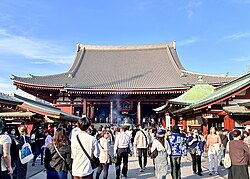
- Senso-jiTempleStroller friendlyDiaper changing tableElevator1.9 kmTokyo's oldest temple, approached through a stone-paved shopping street from the great gate.
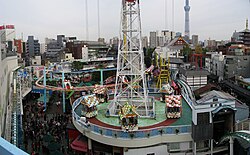
- Asakusa HanayashikiAmusement parkNursing spaceDiaper changing tableElevator1.7 kmA small amusement park, a flower garden in 1853, that calls itself Japan's oldest.
- ASOBono!Indoor playgroundStroller friendlyNursing spaceDiaper changing table2.5 kmAn indoor playground at Tokyo Dome City, its ball pool filled with some 40,000 balls.
- Sumida AquariumAquariumStroller friendlyNursing spaceElevator3.0 kmAn aquarium at the foot of Tokyo Skytree, built so you get close to the animals.


- Ueno Seiyoken HontenWestern restaurantNursing spaceDiaper changing tableElevator5 min walkWestern food in a corner of Ueno Park, from a restaurant founded in 1872.
- Asakusa Imahan Kokusai Street Head RestaurantSukiyaki & shabu-shabuStroller friendlyElevator1.5 kmA sukiyaki and shabu-shabu house in Asakusa since 1895, serving only female black wagyu.
- Solamachi Tabe-Terrace Food CourtFood courtStroller friendlyNursing spaceDiaper changing table3.0 kmA food court at the foot of Skytree: udon, ramen and rice bowls at one table.
- Tokyo National MuseumNational museumStroller friendlyNursing spaceDiaper changing table5 min walkJapan's oldest museum, six buildings on one site, showing almost only real objects.
- Ueno ZooZooStroller friendlyNursing spaceDiaper changing table5 min walkJapan's first zoo, with about 300 species spread over two gardens.
- Senso-jiTempleStroller friendlyDiaper changing tableElevator1.9 kmTokyo's oldest temple, approached through a stone-paved shopping street from the great gate.
- Sumida AquariumAquariumStroller friendlyNursing spaceElevator3.0 kmAn aquarium at the foot of Tokyo Skytree, built so you get close to the animals.
- Ueno ParkCity parkStroller friendlyNursing spaceDiaper changing table10 min walkOne of Japan's first public parks, with the zoo and museums inside its grounds.
- Asakusa HanayashikiAmusement parkNursing spaceDiaper changing tableElevator1.7 kmA small amusement park, a flower garden in 1853, that calls itself Japan's oldest.
- ASOBono!Indoor playgroundStroller friendlyNursing spaceDiaper changing table2.5 kmAn indoor playground at Tokyo Dome City, its ball pool filled with some 40,000 balls.
Piggyback Japan guides
- Is It Actually Open? How Japan Announces Closures
Closing days in Japan are often set one month at a time, posted in Japanese on the official site. The trip planner you used probably never read them.
- A Rainy Day in Tokyo with Small Children
Four indoor places that work when the forecast turns — with the closing days, the reservation traps and the one that will not let a stroller inside.
- One Day in Ueno with Small Children
Four places inside one park — the zoo, the science museum, the park itself and the market street. What closes on Mondays, where to change a diaper, and what the pandas situation is now.
Where it is
Before you go
- Outside stands a full-size model of a blue whale, the largest mammal on earth. In the same outdoor area is the launcher used for the Lambda rocket that put Ohsumi, Japan's first satellite, into orbit.source
- The D51 steam locomotive outside was built in 1939 and stayed in service until 1975; it is the classic Japanese freight locomotive, and 1,115 of them were made.source
More notes (12)
- One floor below ground in the Global Gallery is the dinosaur floor, where complete skeletons stand side by side, including a Tyrannosaurus replica, a Triceratops, and an Apatosaurus.source
- Theater 36-Maru, one floor below ground in the Japan Gallery, is a dome 12.8 meters (42 feet) across — a millionth the size of the earth — with the whole inner surface used as the screen. You watch from a bridge that crosses the middle, standing, because there are no seats. Each showing runs about six minutes, takes 40 people first come, first served, and is covered by the permanent-exhibit ticket, with the room emptied between shows. Preschool children cannot go in on their own, and the film gives a strong sense of floating and speed, which is worth thinking about with a small child. The program changes every month.source
- The parent-and-child exploration room (Compass), on the third floor of the Global Gallery, is for children from newborn through sixth grade together with an adult of 18 or over, and is aimed mainly at ages 4 to 6; children on their own and adults on their own cannot go in. Each session runs 45 minutes and takes 60 people, with the room cleared in between, and sessions start at 10 and 11 a.m. and at 1, 2, and 3 p.m. Everyone who goes in, from babies to adults, needs a reservation for a set date and time and pays the fee. On Wednesdays, Saturdays, and Sundays, staff run a workshop in the 1 p.m. and 2 p.m. sessions.source
- The Japan Gallery building is an exhibit in its own right: built in 1931 to a solid, neo-Renaissance design by the education ministry of the time, it was designated a National Important Cultural Property in 2008. From the air it takes the shape of an airplane, which stood for the cutting edge of science and technology in the years it went up.source
- In the central hall of the Japan Gallery, the museum singles out the domed ceiling and its stained glass as the thing to look up at.source
- On the second floor of the Japan Gallery, Hachiko stands beside Jiro: Hachiko was the Akita who kept waiting at Shibuya Station for an owner who had died, and Jiro was the sled dog who survived a winter with Taro at Showa Station in Antarctica after the base was left empty.source
- Hachiko is there as a taxidermy mount, catalogued on the second floor of the Japan Gallery, north wing, in the Japanese and Nature section, under two headings: living things around people and society, and animals the Japanese have bred.source
- Jiro the Karafuto dog is a taxidermy mount as well, in that same Japanese and Nature section on the second floor of the Japan Gallery, north wing, catalogued under the same headings as Hachiko.source
- The third floor of the Global Gallery holds 115 mounted large animals, the Yoshimoto Collection among them. On the same floor are a Japanese wolf, one of only three mounts of the species left in Japan, and the giant pandas Fei Fei and Tong Tong, who lived at Ueno Zoo.source
- The first floor of the Global Gallery has another giant panda from Ueno Zoo, Huan Huan.source
- The permanent exhibits sit in two buildings. The Japan Gallery runs from one floor below ground to the third floor, with every level split into a south wing and a north wing: the third floor covers the face of the Japanese islands and how the islands formed, the second the living things of the islands and the Japanese and nature, and the first the craft of observing nature. The Global Gallery runs from three floors below ground to the third floor.source
- Meals and rest are on the first basement of the Japan Gallery, in a lounge of about 100 seats with vending machines for cold drinks; the museum warns that this lounge gets extremely crowded in wet weather. The Whale Cafe, 38 seats, is inside that lounge, and the Museion restaurant, 140 seats, is on the mezzanine of the Global Gallery. The roof of the Global Gallery has a herb garden and a sky deck, both closed in bad weather.source
Basics
- Fee:¥630 (general & university students) · elementary through high school free · under-18s (through the first March 31 after turning 18) and 65+ free with ID showing agesource
- Hours:9:00-17:00 (last entry 30 min before closing); closed Mon (Tue if Sun or Mon is a holiday) & Dec 28-Jan 1; open daily in August. Times can change during special exhibitions — check the official calendarsource
- Time to allow:2.5 h
- Booking:E-tickets available via the external 'Asoview!' sitesourceOfficial booking site ↗
- Note: the parent-and-child exploration room 'Compass' (Global Gallery 3F, aimed mainly at ages 4-6) requires a timed reservation for everyone, including babiessource
Basics in detail (4)
- Note that the parent-and-child exploration room (Compass), on the third floor of the Global Gallery and aimed mainly at ages 4 to 6, requires a reservation for a set date and time for every person, including babies.source
- Open 9:00 a.m. to 5:00 p.m., with last entry 30 minutes before closing. Closed Mondays — or Tuesday, when the Sunday or Monday is a public holiday — and closed December 28 through January 1, with no closed days in August. Special exhibitions can change this, so check the official calendar.source
- Admission is 630 yen for adults and university students. Elementary, junior high, and high school students get in free, as does anyone under 18 — counted through the first March 31 after their eighteenth birthday — and anyone 65 or over, on showing proof of age.source
- Electronic tickets are sold through Asoview, an outside ticketing site.source
Once you've decided
evidence & sources (7)
- Official: Stroller friendly, Stroller rental, Nursing space
- Official: Elevator
- Official: English support
- Official: main site
Two buildings in Ueno make up Japan's national science museum, with a full-size blue whale model outside. A steam locomotive and the launch frame for the country's first satellite stand alongside it. The Global Gallery has dinosaur skeletons, a hall of 115 preserved animals, and 'Compass,' a room children and grown-ups enjoy together. The Japan Gallery is a 1931 landmark shaped like an airplane seen from above.
| Stroller friendly | Yes | 2 loaner strollers at the entrance information counter (no reservations — available when not in use) | Web-checked | checked Aug ’26 | kahaku.go.jp |
|---|---|---|---|---|---|
| Stroller rental | Yes (2) | At the entrance information counter; no reservations — available when not in use | Web-checked | checked Aug ’26 | kahaku.go.jp |
| Nursing space | Yes (2) | Japan Gallery B1F (back of the lounge) and Global Gallery 3F (escalator side); hot water not stated online | Web-checked | checked Aug ’26 | kahaku.go.jp |
| Diaper changing table | Yes | Accessible restrooms on every floor except Global Gallery B1F, plus Japan Gallery B1F/1F/2F and inside the B1F nursing room | Web-checked | checked Aug ’26 | kahaku.go.jp |
| Family restroom | Yes | Multipurpose (accessible) restrooms across both buildings; some with adult-size changing beds | Web-checked | checked Aug ’26 | kahaku.go.jp |
| English support | English menu & signs | Audio guide & 'Kahaku Navi' tablet in English, Chinese, Korean, Japanese + a kids' Japanese version (¥320, cash only; photo ID needed for the tablet). Free smartphone 'Kahaku HANDY GUIDE' in English, Chinese & Korean (no audio) | Web-checked | checked Aug ’26 | kahaku.go.jp |
| Child switch (rider swap) | Not checked yet | ||||
| Elevator | Yes | Wheelchair-accessible elevators listed on the official floor map (per-floor locations on the map) | Web-checked | checked Aug ’26 | kahaku.go.jp |
| Indoor / outdoor | Not checked yet | ||||
| Kids' toilet seat & step stool | Not checked yet | ||||
| Diaper disposal bin | Not checked yet | ||||
| Outside food allowed | Not checked yet | ||||
| Steps & slope caution | Not checked yet |