
Osaka Castle
A castle keep rebuilt in 1931 by public donation, holding an eight-floor museum inside.
piggybackjapan.com


Osaka Castle
SaveA castle keep rebuilt in 1931 by public donation, holding an eight-floor museum inside.
The Tokugawa buried Hideyoshi's castle; a hall beside the keep takes you down to it.
MoreWhat kind of place
The keep standing now is the third on this ground, after Hideyoshi's and the Tokugawa's, rebuilt in 1931 with money donated by the people of Osaka.
The stone walls, moats, gates and turrets around it all date from the Tokugawa period or later, and the grounds are a National Special Historic Site.
Inside are eight floors of museum, the top one an observation deck 50 meters (about 165 feet) above the ground.
The odd part is underground: after taking the castle, the Tokugawa buried Hideyoshi's stone wall under a huge mound of earth to erase his family from the site.
A hall two minutes southeast of the keep now takes you down to the stretch of it uncovered in 1984, on the same ticket.
With kidsThe part that matters
Every station leaves a 15- to 20-minute walk to the keep, up paved slopes most of the way, though the park's road train and electric cart cover part of it and take a stroller aboard as it is.
Inside, a small figure of the warlord Hideyoshi moves through 19 mechanical scenes, and two floors down miniature armies fight out the siege that ended his house — neither asks a child to read anything.
The viewing space upstairs narrows and gets crowded, so you are asked to leave the stroller outside the keep: tell the staff at the ticket gate and they check it for free.
The elevator inside runs up only and stops at the fifth floor, so you climb from there to the eighth-floor deck and come all the way back down on stairs.
The keep is run as a museum, so nothing may be eaten or drunk inside and meals happen out in the park.
Sources and evidence (3)
- Updated 2026-04-17. Gives the festival window (Mar 10-May 24) instead of guessing at peak bloom.source
- The floor plans mark the single 2F restroom, the changing table and the first-aid room — none of it is on the website.source
- Names the easiest station (Tanimachi 4-chome) and marks every steep stretch — the one sheet a stroller family needs.source
By age0-1 / 2-3 / 4-6
- Ages 0-1Inside the park you can move with a stroller. If the sloped paths get hard, the park's Road Train and Electric Car both take you aboard with the stroller as it is. The 8th floor of the keep is an observation deck 50 meters up, and the entrance on that floor is passable by wheelchair.Strollers are, as a rule, asked to stay out of the keep, and are checked free of charge at the ticket-gate entrance. For nursing and diaper changes, the private rooms on the park side are the sure thing: one room on the 1st floor of MIRAIZA OSAKA-JO (daily 9:00-22:00, one changing table, sink and kettle) and two on the 1st floor of JO-TERRACE OSAKA (daily 7:00-23:00, two changing tables, sink, no kettle). Both are women-only. There is no nursing room inside the keep, but staff will let you use the first-aid room next to the office on 2F. The only changing table in the keep is in the women's restroom on 2F; a father can ask a staff member and be shown to a separate room.
- Ages 2-3On 7F, Karakuri Taikoki is a diorama of 19 scenes, one to two minutes each, in which a tiny Hideyoshi moves about inside the miniature sets. On 5F, the World of the Summer Battle of Osaka Screen recreates the clash between Sanada Yukimura's and Matsudaira Tadanao's forces with miniature figures. The official park map marks a playground with play equipment on the Morinomiya side.There is only one restroom inside the keep, on 2F, the same floor as the first-aid room and the office. The keep is a museum, so eating and drinking inside are not allowed; only benches for resting are provided. Eat on the park side: cafes at JO-TERRACE OSAKA, MIRAIZA OSAKA-JO and the Morinomiya fountain area, a convenience store with seating at the Babacho front entrance, and three free water points. The castle itself notes that the viewing space narrows on the upper floors and gets very crowded.
- Ages 4-6On 2F, the helmet and surcoat try-on corner lets a child put on a reproduction warlord's helmet and jinbaori and be photographed with your own camera (500 yen per person per turn). A commemorative stamp sits on the same floor. The observation deck on 8F is 50 meters up. Two minutes' walk from the keep, the Toyotomi Ishigaki Museum takes you underground to Hideyoshi's stone wall, which the Tokugawa buried under fill; your keep ticket admits you.The elevator inside goes up only, for everyone, and runs only as far as 5F. From 5F to 8F, and all the way down from 8F to 1F, you take the stairs. (6F is a closed corridor with no exhibits.) Junior-high age and under enter free, but proof is required, such as a passport for under-15s from abroad. It is a 15-to-20-minute walk from the stations, and the castle recommends Tanimachi 4-chome: about 1.1 km to Sakura-mon with about 10 m of climb. Open 9:00-18:00 with last admission 17:30, and the ticket queue may be closed off earlier than 17:30 depending on conditions.
By weatherRain, heat, cold
- Rainy dayThe keep is a museum, so the sights are the exhibits inside. Getting there, though, is a 15- to 20-minute walk outdoors from any station.
- Hot dayNot checked yet
- Cold dayNot checked yet
Time needed2 h
How was it with your kids?
Not greatGreat
- ElevatorElevator:with conditionsconditions
- Stroller OKStroller friendly:with conditionsconditions
- RentalStroller rental:not checked
- NursingNursing space:with conditionsconditions
- ChangingDiaper changing table:with conditionsconditions
- Family WCFamily restroom:with conditionsconditions
- Own foodOutside food allowed:none
- EnglishEnglish support:with conditionsconditions
* Other not checked (4)
Diaper disposal bin, Kids' toilet seat & step stool, Indoor / outdoor, Child switch (rider swap)
Green = we confirmed it. Gray = not checked yet. Gray with a line through = the place does not have it.
Worth a look before you go
Japanese · opens translatedOfficial
Updated 2026-04-17. Gives the festival window (Mar 10-May 24) instead of guessing at peak bloom.
The park's own cherry blossom page: about 3,000 trees and the spring festival dates
Official
The floor plans mark the single 2F restroom, the changing table and the first-aid room — none of it is on the website.
Official English leaflet: floor-by-floor guide to the keep, with restrooms, elevators and the armor try-on
Japanese · opens translatedOfficial
Names the easiest station (Tanimachi 4-chome) and marks every steep stretch — the one sheet a stroller family needs.
Official barrier-free map: distance and height gain to the keep from each of the four stations
Osaka Castle · Links & reads ▾
Where to go next
- Kids Plaza OsakaChildren's museumStroller friendlyNursing spaceDiaper changing table2.4 kmA children's museum built to be touched, the first of its kind in Japan.
- Kuromon MarketFood market streetDiaper changing table3.1 kmPufferfish and fruit out front, shop after shop, down one straight street.
- Jiyuken Namba HontenWestern-style dinerStroller friendly3.2 kmOsaka's first Western-style restaurant, opened in Namba in 1910.
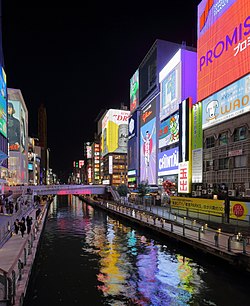
- DotonboriEntertainment districtStroller friendly3.0 kmAn entertainment street along a canal finished in 1615 and named for its digger.
- Umeda Sky Building (Kuchu Teien Observatory)Observation deckStroller friendlyNursing spaceElevator3.9 kmTwo Osaka skyscrapers joined at the top by an open rooftop deck, 173 meters up.
- Hozenji Yokocho3.0 kmHozenji Yokocho is two stone-paved lanes lined with about 60 restaurants, beside a small temple.




- SHINSAIBASHI-SUJI SHOPPING STREETStroller friendly2.7 kmA covered shopping arcade 580 meters long, running north from Dotonbori to Nagahori-dori.
- Osaka Municipal Nagai Botanical GardenBotanical gardenStroller friendlyNursing spaceDiaper changing table8.7 kmRoses, hydrangeas, peonies: eleven collections in a botanical garden inside Nagai Park.
- Osaka Aquarium KaiyukanAquariumStroller friendlyNursing spaceDiaper changing table9.6 kmAn aquarium arranged by region around the Pacific Rim, holding some 620 species.
- Universal Studios JapanMovie theme parkStroller friendlyNursing spaceDiaper changing table8.9 kmA film theme park on Osaka Bay, its ten areas including Mario and Harry Potter worlds.


- Kids Plaza OsakaChildren's museumStroller friendlyNursing spaceDiaper changing table2.4 kmA children's museum built to be touched, the first of its kind in Japan.
- DotonboriEntertainment districtStroller friendly3.0 kmAn entertainment street along a canal finished in 1615 and named for its digger.
- Umeda Sky Building (Kuchu Teien Observatory)Observation deckStroller friendlyNursing spaceElevator3.9 kmTwo Osaka skyscrapers joined at the top by an open rooftop deck, 173 meters up.
- Hozenji Yokocho3.0 kmHozenji Yokocho is two stone-paved lanes lined with about 60 restaurants, beside a small temple.
- Osaka Municipal Nagai Botanical GardenBotanical gardenStroller friendlyNursing spaceDiaper changing table8.7 kmRoses, hydrangeas, peonies: eleven collections in a botanical garden inside Nagai Park.
- Osaka Aquarium KaiyukanAquariumStroller friendlyNursing spaceDiaper changing table9.6 kmAn aquarium arranged by region around the Pacific Rim, holding some 620 species.
Where it is
1-1 Osakajo, Chuo-ku, Osaka-shi, Osaka 540-0002source
Before you go
- The keep standing now is the third, after Hideyoshi's and the Tokugawa's, rebuilt in 1931 with money donated by the people of Osaka. The stone walls, the moats and the surviving old buildings — the main gate (Otemon), the Tamon turret, the Sengan turret — all date from the Tokugawa period or later. The grounds are a National Special Historic Site, and most of those old buildings are Important Cultural Properties.source
- The eighth floor is the observation deck, 50 meters (about 165 feet) up, looking out over the whole castle and the city around it, and its doorway is wide enough to pass through in a wheelchair.source
More notes (18)
- The elevator inside goes up only, and only as far as the fifth floor, which leaves the climb from five to eight and the whole descent from eight to one on stairs. Visitors in a wheelchair or with trouble walking can use it both ways on every floor. The sixth floor is a closed gallery with nothing to see.source
- On the second floor you can put on a reproduction warlord's helmet and surcoat and take your own photographs, 500 yen a turn, with the commemorative stamp on the same floor.source
- There is exactly one restroom inside the keep, on the second floor, alongside the first aid room and the office.source
- The fifth floor rebuilds the fiercest fighting of the summer siege — Sanada Yukimura's men against Matsudaira Tadanao's — in miniature figures, while the seventh runs 19 dioramas of one to two minutes each in which a small Hideyoshi moves through the scenery.source
- The theater on the first floor plays five short films about Hideyoshi and the castle, about six minutes each, with subtitles in Japanese, English, Korean and Chinese.source
- The third floor holds a full-size reconstruction of the portable golden tea room Hideyoshi had built, along with models of the castle as it stood under the Toyotomi and under the Tokugawa. Photography is barred on the third and fourth floors, where the exhibits rotate roughly every two months to protect them.source
- A hall southeast of the keep, two minutes on foot, takes you underground to the stone wall Hideyoshi built — after the summer siege the Tokugawa buried it under a huge mound of earth to wipe out any trace of his family's authority. Your keep ticket covers it.source
- There is no restroom inside the stone wall hall, and what it shows is the wall of the innermost enclosure uncovered in a 1984 excavation, which the operator warns may close without notice depending on the condition of the stones.source
- The official wording is that the viewing space narrows and gets very crowded on the higher floors, which is why you are asked to leave a stroller outside the keep; the ticket gate checks it for free.source
- The ticket line may be cut off before 5:30 p.m. depending on conditions, since last entry has to be worked backward from closing. There are no coin lockers inside either; bags go to the ticket office at 100 yen apiece, accepted from 9 a.m. to 5:30 p.m. and collected by 6 p.m.source
- The keep is run as a museum, so eating and drinking are not allowed inside, though there are benches if you need to sit down.source
- The official leaflet puts every station 15 to 20 minutes on foot from the keep, and drones are banned across the whole park.source
- The barrier-free map gives the distance and the climb from each station to the Sakuramon gate. Tanimachi 4-chome is the recommended route, about 1.1 kilometers (0.7 miles) with roughly 10 meters (33 feet) of rise; Tenmabashi and Morinomiya are about 1.3 kilometers (0.8 miles) and Osakajokoen about 1.4 (0.9 miles), each climbing some 20 meters (65 feet). From the gate to the keep is another 0.3 kilometers (0.2 miles) and 5 meters (16 feet), all on paved slopes with a few steep stretches.source
- If the slopes are too much, the park runs a road train and an electric cart that take a stroller or a wheelchair aboard as it is. The road train links Morinomiya Station and the terrace complex by Osakajokoen Station with the Gokurakubashi bridge; the cart links Bamba-cho, near Tanimachi 4-chome, with the area around the Sakuramon gate. Both are off on the first Thursday of every month (the following day if that is a holiday) and the fourth Thursday of even-numbered months, and may stop in rough weather.source
- Two spots in the park are registered with the city as baby stations for nursing and diaper changes: the building beside the keep (MIRAIZA OSAKA-JO), open 9 a.m. to 10 p.m. daily, and the terrace complex in front of Osakajokoen Station (JO-TERRACE OSAKA), open 7 a.m. to 11 p.m. daily.source
- The plum grove east of the inner moat covers about 1.7 hectares (4.2 acres) with roughly 1,245 trees in 105 varieties, and it began as a gift — graduates of Kitano High School donated 880 trees in 22 varieties to the city for their school's centenary, and the grove opened in March 1974.source
- Around 3,000 cherry trees, mostly Somei-Yoshino, make this one of the best-known blossom sites in western Japan, and in 2026 the spring festival ran from March 10 to May 24, with the official bloom page declaring the cherry season over on April 17.source
- The park map's legend includes playground equipment, marking a play area on the Morinomiya side, and the only things that map forbids are drones and fishing. It also lists walking times to the keep station by station, from 18 to 21 minutes, with Osakajo-kitazume the farthest at 21.source
Basics
- Fee:¥1,200 adults · ¥600 university and high school students (ID required) · free for children aged 15 and under (ID required). Free for Osaka city residents aged 65+ on showing proof, and for holders of a disability, therapy or A-bomb survivor handbook plus one carer. Group rate for 15 or more paying visitors (¥1,080 / ¥540). Your keep ticket also admits you to the Osaka Castle Toyotomi Stone Wall Museum — though that hall can be closed without notice depending on the condition of the stone wallsource234
- Hours:9:00-18:00 (last entry 17:30); closed Dec 28-Jan 1. It can also close temporarily for exhibition changes or maintenancesource23
- Time to allow:2 h
- Booking:Web tickets are sold online from the official site. There is a ticket counter on site, but the museum states that depending on conditions it may cap the ticket queue before 17:30, allowing for the last-admission timesourceOfficial booking site ↗
- Note: the keep asks you not to bring a stroller inside — staff take yours at the entrance gate and store it freesource
Basics in detail (7)
- You are asked to leave strollers outside the keep; the ticket gate will check yours for free.source
- Open 9 a.m. to 6 p.m. with last entry at 5:30 p.m., closed December 28 through January 1, and shut occasionally without much warning for exhibit changes and maintenance.source
- Adults pay 1,200 yen and university and high school students 600 with proof, while anyone junior high age or younger goes free with proof — a passport does it for visitors from abroad aged 15 and under. Osaka city residents 65 and over, plus holders of a Japanese disability, therapy or atomic-bomb survivor certificate and one carer, are admitted free, and groups of 15 or more paying visitors drop to 1,080 and 540 yen. The same ticket covers the stone wall hall, which can close without notice depending on the condition of the stones.source
- Tickets sell on the official website and at the window, though the operator warns that the ticket line may be closed before 5:30 p.m. depending on conditions, since last entry has to be worked backward from closing.source
- The Somei-Yoshino cherries peak from mid-March to mid-April, with magnolia and purple-leaf plum flowering at the same time and hirado azaleas taking over from mid-April.source
- Lacecap hydrangeas and gardenias run from mid-May to mid-July, and crape myrtle carries on from July to mid-September.source
- Fragrant and silver osmanthus flower from October to mid-November, and the winter-flowering cherry from mid-October to mid-December.source
Once you've decided
evidence & sources (8)
- Official: Stroller friendly, English support, Outside food allowed
- Official: Diaper changing table, English support, Elevator
- osaka-info.jp: Nursing space, Family restroom
- Public agency: Nursing space
- Official: English support
- Official: main site
Rebuilt in 1931 with donations from Osaka's citizens, this concrete castle keep holds an eight-floor museum built for looking rather than reading. Inside are a full-size golden tea room, the summer siege of Osaka in miniature figures, and warlord helmets to try on. The elevator climbs only to the fifth floor; the rest, and the way down, is stairs. The eighth floor is an open deck fifty meters up. A second hall nearby goes underground to the stone wall Hideyoshi built, which the Tokugawa buried to erase his house.
| Stroller friendly | Yes | Fine across the park, but not inside the keep: upper floors get very crowded, so the museum asks you not to bring strollers in and stores them free at the entrance gate — just tell the gate staff. The park's road train and electric car take strollers on board | Web-checked | checked Aug ’26 | osakacastle.netosakacastle.net |
|---|---|---|---|---|---|
| Stroller rental | Not checked yet | ||||
| Nursing space | Yes (3) | Three private nursing booths, all on the park side: MIRAIZA OSAKA-JO 1F has one (women only; 1 changing table, large bed, sink and kettle) and JO-TERRACE OSAKA 1F has two (women only; 2 changing tables, sink, no kettle). Both are registered as Osaka City 'baby stations' — MIRAIZA 9:00-22:00 daily, JO-TERRACE 7:00-23:00 daily. Inside the keep there is no nursing room, but you can use the first-aid room on 2F next to the office | Web-checked | checked Aug ’26 | osakacastle.netosaka-info.jpcity.osaka.lg.jp |
| Diaper changing table | Yes | Inside the keep there is one changing table, in the 2F women's restroom — fathers should ask staff, who will show them to a separate room. In the park, MIRAIZA OSAKA-JO 1F and JO-TERRACE OSAKA (nursing room on 1F, accessible restroom on 2F) both have tables | Web-checked | checked Aug ’26 | osakacastle.netosakacastle.net |
| Family restroom | Yes | One accessible restroom on 2F of the keep and two more outside on Honmaru Plaza. The one inside has no changing table, baby-keep chair or ostomate fittings. Elsewhere in the park, some accessible restrooms do have changing tables and baby-keep chairs | Web-checked | checked Aug ’26 | osakacastle.netosaka-info.jp |
| Diaper disposal bin | Not checked yet | ||||
| English support | English-speaking staff | Audio guides are lent free in English, Chinese, Korean and Japanese (desk open 9:00-17:00, return by 17:30; numbers are limited, so group loans are capped). The 1F theater subtitles all four languages, and the information counters on 1F and 5F are staffed by people who can handle foreign languages. The official site also has leaflets to download in English, Korean and both Chinese scripts | Web-checked | checked Aug ’26 | osakacastle.netosakacastle.netosakacastle.net |
| Outside food allowed | No | The keep is a museum, so eating and drinking inside is not allowed (there are benches to rest on). Eat on the park side instead: cafes at JO-TERRACE OSAKA, MIRAIZA OSAKA-JO and the Morinomiya fountain area, a convenience store with seating at the Babamachi entrance, and three free water refill points | Web-checked | checked Aug ’26 | osakacastle.netosakacastle.net |
| Kids' toilet seat & step stool | Not checked yet | ||||
| Elevator | Yes | The indoor elevator is up-only for everyone and runs straight to 5F; from 5F to 8F, and all the way back down from 8F, you take the stairs. Wheelchair users and people who find walking difficult can use it on every floor, and can ride straight to the 8F deck — ask a staff member. The outdoor elevator from the ground-level ticket counter up to the keep entrance is also staff-guided and is for wheelchair users and people who find walking difficult, not for general use. An elevator reaches the underground stone-wall hall of the Toyotomi Stone Wall Museum | Web-checked | checked Aug ’26 | osakacastle.netosakacastle.netosakacastle.net |
| Steps & slope caution | Barrier-free | The official map calls the keep a barrier-free facility with an elevator, and publishes a barrier-free route from each station. Even so, you climb a paved slope to get there: the ramp between the outdoor elevator and the entrance is about 7 degrees, and the path from Gokurakubashi on the north side is steep with stretches that have no handrail. Corridors inside are 120cm wide but narrow when busy | Web-checked | checked Aug ’26 | osakacastle.net |
| Indoor / outdoor | Not checked yet | ||||
| Child switch (rider swap) | Not checked yet |