
Osaka Aquarium Kaiyukan
An aquarium arranged by region around the Pacific Rim, holding some 620 species.
piggybackjapan.com

Osaka Aquarium Kaiyukan
SaveAn aquarium arranged by region around the Pacific Rim, holding some 620 species.
The same whale shark tank meets you again on every floor down.
MoreWhat kind of place
The theme is the Pacific Ring of Fire, the arc of active volcanoes around the ocean, so the tanks are grouped by region instead of by kind of animal — a Japanese forest stream, the Antarctic, Monterey Bay, the Tasman Sea — with about 620 species and 30,000 animals in all.
On the way down you meet the same Pacific tank at its top, middle and bottom, a sequence the aquarium likens to diving nine meters (about 30 feet).
The tanks are acrylic rather than glass, and when the aquarium opened its panels came to one and a half times the world's annual production of the material.
The Pacific tank's wall runs up to 30 centimeters (about 12 inches) thick, and one of the real panels is set out on the fourth floor where the route passes.
With kidsThe part that matters
You go up first: an escalator to the eighth floor, then a long, mostly ramped walk back down to the exit.
The Pacific tank runs through the middle of the building, so the whale shark comes back into view floor after floor.
That is why a crowd at the first window costs you nothing: keep walking and you meet the same tank a floor down, or wait the crush out on one of the benches along the ramps.
Meals belong at the fourth-floor cafe, since eating in the viewing corridors is not allowed, though baby food and a drink in a lidded bottle are fine on a bench.
Buy a timed ticket before you go and you walk straight in instead of queuing at the window, and plan on one visit straight through, because once you leave you cannot come back in.
Sources and evidence (6)
- A reporter walks it with children: the long escalator to 8F is where staff take a stroller to the elevator.source
- Made by the aquarium for wheelchair users; a stroller takes exactly the same detours.source
- You cannot eat a meal inside the aquarium, so this is where the meal actually happens.source
- For when rain rewrites the day: eleven other indoor options in the same city.source
- Osaka Metro's own release — how to be sure you got off at the right station.source
- On show in the Arctic zone now; the aquarium gives no end date and says it may change without notice.source
By age0-1 / 2-3 / 4-6
- Ages 0-1Almost the whole aquarium is ramps, so you spiral down from the 8th floor to the 3rd with the stroller still in your hands. The same Pacific Ocean tank comes round again at upper, middle and lower levels, so missing the whale shark once still means meeting it again further on. Benches sit along the route, and if it gets crowded you can sit and let the flow of people settle.The nursing rooms are the Baby Care Room on Entrance Building 2F, which has a formula-water dispenser, and a private room behind the Aqua Gate tank, which has no hot water and no diaper changing. The official accessibility map also marks a nursing room on 6F inside the aquarium. Diaper changing tables are in restrooms throughout. Only strollers of the shape the aquarium specifies may come in — 85 cm wide or less, pushed from behind, with a wheel lock and a safety belt — and none are lent out. There is no re-entry, so carry in what you will need.
- Ages 2-3The route starts on 8F in the Japan Forest, with the sound of a waterfall and green moss. Then penguins in Antarctica, Pacific white-sided dolphins in the Tasman Sea, a huge shoal of sardines on the Chilean rocky shore, and at the end, jellyfish drifting in Jellyfish Galaxy on 3F. From 3F up to the ringed seal tank on 4F, you ride the elevator yourselves.There are no dolphin or sea lion shows, and the aquarium explains why: it wants the animals watched in something close to their natural state. Staff do not page over a PA system, and lost children are handled at the information desk beside the ticket windows. Eating in the viewing corridors is not allowed; the one place to eat is cafe R.O.F on 4F. What you may carry in is drinks in lidded containers that will not spill if knocked over, and baby food.
- Ages 4-6With the Kaiyukan Expedition Stamp Note (400 yen) in hand, a child matches a silhouette to the right creature and presses all 11 stamps hidden around the aquarium themselves. The aquarium says the notebook works for preschoolers too. Each tank's name board hides the creatures that live in that tank. On 4F, a real piece of the Pacific Ocean tank's acrylic panel, up to 30 cm thick, is on display.The stamp notebook is sold at the official shop on Entrance Building 3F, before the entry gate. The children's toilet is likewise before the gate, inside the Baby Care Room on Entrance Building 2F. Since there is no re-entry, stop at both on the way in. Most visitors take about two hours to go round. Buying at the window on the day can mean a long wait, so the aquarium recommends buying a timed Kaiyukan e-ticket in advance.
By weatherRain, heat, cold
- Rainy dayThe official FAQ answers "Is a rainy day a problem?" with "It is an indoor facility, so viewing is not affected." Depending on which parking lot you use you may need an umbrella to reach the entrance, and umbrellas 120 cm or longer cannot be brought inside.
- Hot dayNot checked yet
- Cold dayNot checked yet
Time needed2 h
How was it with your kids?
Not greatGreat
- ElevatorElevator:with conditionsconditions
- Stroller OKStroller friendly:with conditionsconditions
- RentalStroller rental:none
- NursingNursing space:with conditionsconditions
- ChangingDiaper changing table:with conditionsconditions
- Family WCFamily restroom:with conditionsconditions
- Kids' toiletKids' toilet seat & step stool:with conditionsconditions
- Own foodOutside food allowed:none
- EnglishEnglish support:with conditionsconditions
* Other not checked (6)
Diaper disposal bin, Child switch (rider swap), Fathers welcome, Microwave, Official family-friendly certification, Quietness (guide)
Green = we confirmed it. Gray = not checked yet. Gray with a line through = the place does not have it.
Worth a look before you go
Japanese · opens translatedGuide
A reporter walks it with children: the long escalator to 8F is where staff take a stroller to the elevator.
Walking the whole route with kids: up to 8F by escalator, then downhill all the way
 YouTube
Japanese · opens translatedVideo
Made by the aquarium for wheelchair users; a stroller takes exactly the same detours.
Official 52-second video: the points inside where staff take wheels round by elevator
Japanese · opens translatedGuide
You cannot eat a meal inside the aquarium, so this is where the meal actually happens.
Eating next door: the food court and the 1960s food alley beside the aquarium
Japanese · opens translatedGuide
For when rain rewrites the day: eleven other indoor options in the same city.
Twelve indoor places in Osaka for a rainy day, with the aquarium among them
Japanese · opens translatedOfficial
Osaka Metro's own release — how to be sure you got off at the right station.
The nearest subway station now also signed Kaiyukan-mae, with a decorated exit passage
More to look at
Osaka Aquarium Kaiyukan · Links & reads ▾
Where to go next
- Universal Studios JapanMovie theme parkStroller friendlyNursing spaceDiaper changing table1.4 kmA film theme park on Osaka Bay, its ten areas including Mario and Harry Potter worlds.
- Kids Plaza OsakaChildren's museumStroller friendlyNursing spaceDiaper changing table9.2 kmA children's museum built to be touched, the first of its kind in Japan.
- Jiyuken Namba HontenWestern-style dinerStroller friendly6.8 kmOsaka's first Western-style restaurant, opened in Namba in 1910.
- Kuromon MarketFood market streetDiaper changing table7.2 kmPufferfish and fruit out front, shop after shop, down one straight street.
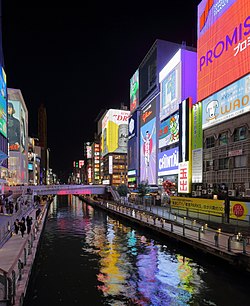
- DotonboriEntertainment districtStroller friendly6.8 kmAn entertainment street along a canal finished in 1615 and named for its digger.
- Osaka CastleCastleStroller friendlyNursing spaceDiaper changing table9.6 kmA castle keep rebuilt in 1931 by public donation, holding an eight-floor museum inside.



- Osaka Municipal Nagai Botanical GardenBotanical gardenStroller friendlyNursing spaceDiaper changing table9.8 kmRoses, hydrangeas, peonies: eleven collections in a botanical garden inside Nagai Park.
- SHINSAIBASHI-SUJI SHOPPING STREETStroller friendly7.0 kmA covered shopping arcade 580 meters long, running north from Dotonbori to Nagahori-dori.
- Umeda Sky Building (Kuchu Teien Observatory)Observation deckStroller friendlyNursing spaceElevator7.9 kmTwo Osaka skyscrapers joined at the top by an open rooftop deck, 173 meters up.
- Hozenji Yokocho6.9 kmHozenji Yokocho is two stone-paved lanes lined with about 60 restaurants, beside a small temple.


- Kids Plaza OsakaChildren's museumStroller friendlyNursing spaceDiaper changing table9.2 kmA children's museum built to be touched, the first of its kind in Japan.
- DotonboriEntertainment districtStroller friendly6.8 kmAn entertainment street along a canal finished in 1615 and named for its digger.
- Osaka CastleCastleStroller friendlyNursing spaceDiaper changing table9.6 kmA castle keep rebuilt in 1931 by public donation, holding an eight-floor museum inside.
- Osaka Municipal Nagai Botanical GardenBotanical gardenStroller friendlyNursing spaceDiaper changing table9.8 kmRoses, hydrangeas, peonies: eleven collections in a botanical garden inside Nagai Park.
- Umeda Sky Building (Kuchu Teien Observatory)Observation deckStroller friendlyNursing spaceElevator7.9 kmTwo Osaka skyscrapers joined at the top by an open rooftop deck, 173 meters up.
- Hozenji Yokocho6.9 kmHozenji Yokocho is two stone-paved lanes lined with about 60 restaurants, beside a small temple.
Where it is
1-1-10 Kaigandori, Minato-ku, Osaka-shi, Osaka 552-0022source23
Before you go
- The exhibits follow the Pacific Ring of Fire, the arc of active volcanoes that circles the ocean, so the tanks are grouped by region — North America, the Antarctic, temperate and tropical waters — running from a Japanese forest stream at the start to the deep-sea animals of the Japan Trench, about 620 species and 30,000 animals in all.source
- You walk the building from the top down: in through the tunnel tank at the entrance (Aqua Gate) on the third floor, up an escalator to the forest exhibit on the eighth, then down through the seventh, sixth, fifth and fourth floors to the jellyfish gallery on the third, and out. That route passes the same Pacific tank at its upper, middle and lower levels — a sequence the aquarium likens to diving nine meters (about 30 feet) — and the animals and their behavior change with the depth.source
More notes (12)
- The Pacific tank holds a whale shark, devil rays and schools of mackerel. Feeding happens at the surface, so the upper level gets the closest view, but the whale shark tipping upright to suck its food in is easy to follow from the lower levels too.source
- The aquarium is blunt about its own crowds. People stop and bunch up at the corner just past the Great Barrier Reef tank, where the Pacific tank first comes into view; since that same tank returns many times further along, the advice is to keep walking. Benches set along the route let you sit out a feeding-time crush. And on weekday mornings from early February to early March, from mid-April to the end of May (outside Golden Week) and from October to early December, school groups fill the building, so the aquarium suggests coming after noon.source
- Admission is released in 15-minute batches, so buying at the window on the day can mean a long wait — worst over school holidays, weekends and public holidays. A timed e-ticket bought ahead lets you walk straight in.source
- The jellyfish gallery on the third floor closes the route — a space made to look like a galaxy, with the jellyfish hanging in it as if weightless. The aquarium describes what you are looking at as transparency, drift and stillness.source
- The Arctic exhibit spreads over two floors, the ice above and the water below. The ringed seals are here, and you reach their tank by taking the elevator up from the third floor to the fourth yourself.source
- The route opens on the eighth floor in a Japanese forest — a waterfall sounding through it, moss greener where the spray hits it, trees that change with the season and the animals of a mountain stream. The aquarium frames it as the scene you would find if otters still lived in Japan.source
- Pacific white-sided dolphins swim in the Tasman Sea tank, penguins stand in the Antarctic exhibit, sea lions live in Monterey Bay in the group they would form in the wild, and a huge school of sardines wheels over the Chilean rocks. There are no dolphin or sea lion shows here at all — the aquarium gives its reason, that it wants the animals seen closer to how they live in the wild.source
- The tanks are acrylic, not glass. When the aquarium opened, its panels came to one and a half times the world's annual production of the material; the Pacific tank's wall runs up to 30 centimeters (about 12 inches) thick, and one of the real panels is set out on the fourth floor along the route.source
- Nearly the whole building is ramp, which the aquarium admits makes it easy to lose track of where you are. The markers underfoot counting down the distance to the exit and the posted maps are how you find yourself again — and each tank's name board has the animals that live in it hidden somewhere in the design.source
- The official shop on the third floor of the entrance building sells a stamp notebook for children, 400 yen. Each page shows a silhouette to match against the tanks, and pressing the stamp hidden nearby reveals the answer; there are 11 around the building, with a goal to find at the exit. The aquarium says preschoolers can do it too.source
- From 5 p.m. daily the lighting changes over to what the aquarium calls its night hours, when the animals move differently and the light falls through deep blue water like moonlight.source
- Eating is not allowed in the viewing corridors, so the one place to sit down with food is the cafe on the fourth floor (cafe R.O.F), behind the Japan Trench tank, where some seats face the water — outside the gates a drink stand (SEA SAW) sells whale-shark soft serve, and the shopping complex next door (Tempozan Marketplace) has restaurants and a food court.source
Basics
- Fee:Prices change by the date. The aquarium runs demand-based pricing and publishes a price calendar; there are only four bands of visitor — adult (high-school age or 16 and over), child (elementary and junior-high), young child (3 and over) and age 2 and under, who go free. On the twelve months of the official calendar readable on 11 August 2026, published days ranged ¥2,800-3,500 for adults, ¥1,400-1,800 for children and ¥700-900 for young children. A child counts as 'young child' until the 1 April of the school year they start elementary school, and as 'child' until the 1 April of the year they finish junior high. Holders of a Japanese disability certificate and one carer each pay half price, shown at the ticket window. There is no annual passport and no senior discountsource23
- Hours:Opening and closing times change from day to day; the official calendar carries each date. Across the dates published for August and September 2026 the aquarium opened between 8:00 and 10:30 and closed between 20:00 and 21:00. The entrance gate stops admitting people one hour before closing, and that is the last entry — once you are inside you can stay until closing whatever time your ticket says. You may also walk the route a second time from the start, but not after that same last-entry hour has passed, even if you are already inside. From 17:00 the lighting switches to the 'Kaiyukan at night' setting. The aquarium closes for two days each January; the official calendar marks 13 and 14 January 2027. Children under 16 on their own are asked to leave by 19:00, with last entry at 18:00, under the Osaka prefectural ordinancesource23
- Time to allow:2 hsource2
- Booking:You do not have to book ahead — time-slot tickets are sold on the day at the windows and on the web — but each 15-minute slot has a fixed number of tickets, so the aquarium recommends buying a dated-and-timed e-ticket in advance. Same-day tickets can mean a long wait, and the official FAQ says the wait can be long on weekends, public holidays and school holidays. E-tickets go on sale 30 days before your date and need a Webket account. You can move your date and time twice, within the same price band and on days already on sale. Credit-card purchases can be canceled free of charge up to the day itself. You cannot go in before the time printed on the ticketsource23Official booking site ↗
- Note: you cannot go back in. Re-entry ended on 15 June 2026, so plan meals and naps around one continuous visitsource
Basics in detail (5)
- Re-entry ended on June 15, 2026, so meals and naps have to be planned inside the building — stepping out ends the visit.source
- Opening and closing times shift day to day on the official calendar; across the dates published for August and September 2026, doors opened somewhere between 8 a.m. and 10:30 a.m. and closed between 8 p.m. and 9 p.m. The gate stops admitting an hour before closing. Once you are in you can stay until closing whatever hour your ticket named, and you can even walk the route a second time — but only before that last hour, since after it you cannot move into the exhibit areas even from inside. The lighting shifts at 5 p.m., the aquarium closes for two days each January (January 13 and 14 in 2027), and visitors under 16 without an adult must be out by 7 p.m. under an Osaka prefectural ordinance, with last admission at 6 p.m.source
- Prices move with demand and are posted day by day on the official calendar, split into adult (high school age or 16 and over), child (elementary and junior high) and toddler (3 and up), with children 2 and under free. A read of the full 2026–2027 calendar on August 11, 2026 found adults at 2,800 to 3,500 yen, children at 1,400 to 1,800 and toddlers at 700 to 900 on the dates then published. A child moves from the toddler rate to the child rate on April 1 of the year they start elementary school, and to the adult rate on April 1 after junior high. Holders of a Japanese disability certificate and one carer pay half at the window, and there is no annual pass and no senior discount.source
- Booking is not required, since same-day tickets sell at the window and online, but entry is assigned in 15-minute slots with a fixed number sold per slot, so the aquarium pushes its timed e-ticket and warns that same-day buyers may not get the hour they want and that school holidays, weekends and public holidays can mean a long wait. The e-ticket goes on sale 30 days ahead and needs an account on the ticketing site. It allows two date changes within the same price band while sales are open and can be canceled free until the day itself if you paid by card, though you cannot go in earlier than the time printed on it.source
- About 140 sea angels, each around 2 centimeters (under an inch) long, are on show in the Arctic exhibit, collected by the aquarium's own keepers on an Arctic research voyage aboard a Hokkaido University training ship between June 19 and July 31, 2026.source
Once you've decided
evidence & sources (18)
- Official: Stroller friendly, Diaper changing table, Nursing space
- Official: Stroller friendly, Indoor / outdoor, Family restroom
- Official: Stroller friendly, Nursing space, Elevator
- Official: Stroller friendly, Nursing space, Outside food allowed
- Official: Family restroom, Elevator, Stroller rental
- Official: Stroller friendly, Steps & slope caution
- Official: Crowding (guide)
- Official: Stroller access notes
- Official: Outside food allowed
- Official: English support
- Official: main site
This Osaka aquarium is arranged as a journey around the Pacific Rim, region by region, from a Japanese forest to the Arctic. An escalator lifts you to the top floor and the route spirals down from there. Its huge Pacific tank comes back at every level, so you see the whale shark from the surface first and from the deep last. There are no dolphin or sea lion shows; the aquarium says it wants its animals seen closer to how they live in the wild.
| Stroller friendly | Yes | You can push a stroller through: most of the building is gentle ramps. A few links are stairs or escalators, and staff take you round by elevator — tell the nearest member of staff. The official accessibility map marks four places to speak up, including just past the Aqua Gate and at the back of the Japan Forest on 8F. Only strollers of the specified shape may be brought in, and the official rules PDF sets the shape: 85 cm or less wide, pushed from behind, unable to move on their own, with a tire lock and a fall-prevention belt. The aquarium recommends leaving the stroller and walking so that children can get close to the tanks. There is a stroller area outside by the entrance (left of the ticket windows) and none inside; the aquarium takes no responsibility for damage, loss or theft there | Web-checked | checked Aug ’26 | kaiyukan.comkaiyukan.comkaiyukan.comkaiyukan.comkaiyukan.com |
|---|---|---|---|---|---|
| Diaper changing table | Yes | Changing tables are in restrooms all around the aquarium, which the official page describes as private cubicles you can use together with a baby. The Baby Care Room on Entrance Building 2F has a changing bed, and the one in Tempozan Marketplace 3F next door has a changing mat. Note that the small nursing room behind the Aqua Gate tank cannot be used for changing | Web-checked | checked Aug ’26 | kaiyukan.com |
| Nursing space | Yes | The Baby Care Room on Entrance Building 2F has a nursing room, a kids' toilet, a changing bed and a bottle warmer, and there is a private nursing cubicle behind the Aqua Gate tank (no hot water there, and no changing). The official accessibility floor map also marks a nursing-room icon on 6F inside the aquarium. Next door, the Baby Care Room in Tempozan Marketplace 3F has nursing booths, a changing mat, a bottle warmer and a family zone. Feeding a baby anywhere other than a nursing room is not allowed | Web-checked | checked Aug ’26 | kaiyukan.comkaiyukan.comkaiyukan.com |
| Indoor / outdoor | Indoor | Indoors. Asked whether rain is a problem, the official FAQ answers that this is an indoor facility so rain does not affect the visit — but adds that depending on which parking lot you use, you may need an umbrella to reach the entrance | Web-checked | checked Aug ’26 | kaiyukan.com |
| Family restroom | Yes | Barrier-free restrooms are on Entrance Building 2F, before the gate, and on 6F inside. The FAQ adds that wheelchair-accessible restrooms are located throughout the aquarium, the entrance building and Tempozan Marketplace, and the aquarium says its restrooms are private cubicles you can use together with a baby | Web-checked | checked Aug ’26 | kaiyukan.comkaiyukan.comkaiyukan.com |
| Diaper disposal bin | Not checked yet | ||||
| English support | English menu & signs | An audio guide rents for ¥800 including tax and speaks Japanese, English, Chinese, Korean, French and Thai — 33 entries, about 40 minutes in total. Buy it at the ticket window or the service counter and collect it at the service counter on Entrance Building 3F; it comes with earphones using a 3.5 mm jack. The official website itself runs in six languages. Whether the signs inside the aquarium carry English is not stated on the official site | Web-checked | checked Aug ’26 | kaiyukan.com |
| Outside food allowed | No | Eating along the viewing route is not allowed; meals are for cafe R.O.F on 4F inside. What you may bring in and consume is drinks in lidded containers that will not spill if knocked over — a flask or a plastic bottle — and baby food, as long as you sit on a bench rather than eat while walking and do not block other people's view. Open cups and tumblers are not allowed in, nor is alcohol, and drinking alcohol inside is refused. Feeding a baby is only allowed in a nursing room | Web-checked | checked Aug ’26 | kaiyukan.comkaiyukan.comkaiyukan.com |
| Kids' toilet seat & step stool | Yes | A kids' toilet is part of the Baby Care Room on Entrance Building 2F, which is before the entrance gate — worth using on the way in, since you cannot come back out and in again | Web-checked | checked Aug ’26 | kaiyukan.com |
| Elevator | Yes | Elevators exist but are not on the public route everywhere — staff take you to them where needed. The official accessibility map marks four points: just past the Aqua Gate, where an escalator goes up; at the back of the Japan Forest on 8F, at the door to the right of the stairs; after you have seen as far as the 4F escalator, by going back to cafe R.O.F; and from 3F up to the 4F Arctic tank, where you can ride the elevator yourself | Web-checked | checked Aug ’26 | kaiyukan.comkaiyukan.comkaiyukan.com |
| Stroller rental | No | Asked whether strollers can be borrowed, the official FAQ answers that there is no such loan service. Wheelchairs are a different matter: those are lent free of charge at the information desk beside the ticket windows and at the service counter on Entrance Building 3F, in limited numbers | Web-checked | checked Aug ’26 | kaiyukan.comkaiyukan.com |
| Child switch (rider swap) | Not checked yet | ||||
| Steps & slope caution | Barrier-free | Most of the building is ramp, which is why wheels work here at all — the aquarium says almost all of the interior is sloped, that wheelchair users can enjoy it, and that staff will show you to an elevator where needed, so please be assured. Two things to translate for yourself: a few links between floors are stairs or escalators, so you will be waiting for a staff escort at those points, and wheels wider than 85 cm are outside the shape the aquarium allows in. The viewing corridors have marked priority spots called omoiyari zones | Web-checked | checked Aug ’26 | kaiyukan.comkaiyukan.comkaiyukan.comkaiyukan.com |
| Nursing rooms | Yes | A nursing room inside the Baby Care Room on Entrance Building 2F, and a private nursing cubicle behind the Aqua Gate tank. The official accessibility floor map also marks one on 6F | Web-checked | checked Aug ’26 | kaiyukan.comkaiyukan.com |
| Diaper changing tables | Yes | In restrooms throughout the aquarium, plus a changing bed in the Baby Care Room on Entrance Building 2F | Web-checked | checked Aug ’26 | kaiyukan.com |
| Hot water for formula | Yes | Bottle warmers are in the Baby Care Room on Entrance Building 2F and in the one at Tempozan Marketplace 3F next door. The small nursing cubicle behind the Aqua Gate tank has no hot water | Web-checked | checked Aug ’26 | kaiyukan.com |
| Fathers welcome | Not checked yet | ||||
| Microwave | Not checked yet | ||||
| Room privacy | Yes | The nursing space behind the Aqua Gate tank is described as a private room. The Baby Care Room at Tempozan Marketplace 3F has nursing booths and a family zone that a whole family can use | Web-checked | checked Aug ’26 | kaiyukan.com |
| Lost-child supportExtra info — guide only | Yes | The information desk beside the ticket windows takes lost-child reports, along with lost property. There is no paging over a public-address system — the aquarium says it does not do that, and asks you to phone the information line on 06-6576-5501 if you cannot find a member of staff nearby and it is urgent | Web-checked | checked Aug ’26 | kaiyukan.comkaiyukan.com |
| Crowding (guide)Extra info — guide only | Yes | The aquarium publishes its own crowding advice rather than a chart. Entry is metered in 15-minute slots, so buying at the window on the day can mean a long wait, especially on weekends, public holidays and school holidays. Weekdays are quieter, except that school groups fill the mornings in early February to early March, mid-April to end of May outside Golden Week, and October to early December — the aquarium suggests arriving in the afternoon then. Inside, the corner where the Pacific tank first comes into view is where people stop; the same tank comes back several times further on, and there are benches along the route to sit out a crowd | Web-checked | checked Aug ’26 | kaiyukan.comkaiyukan.com |
| Stroller access notesExtra info — guide only | Yes | Two things to settle before the gate. First, the stroller: the parking area is outside, by the entrance and to the left of the ticket windows, and there is none inside, so decide there whether you are pushing or carrying. Second, luggage: since 24 April 2026, suitcases, pet carts, carts and any bag whose three sides add up to 120 cm or more, or with any side over 70 cm, cannot be brought inside — leave them at your hotel or in a coin locker. There are lockers by the aquarium entrance, in Kaiyukan Hall, near the museum shop and elsewhere in Tempozan; the ones inside the paid area are ¥400 size only. Umbrellas 120 cm or longer are also refused | Web-checked | checked Aug ’26 | kaiyukan.comkaiyukan.comkaiyukan.comkaiyukan.com |
| Official family-friendly certificationExtra info — guide only | Not checked yet | ||||
| Quietness (guide)Extra info — guide only | Not checked yet |