Osaka with a baby (0–1) 15 spots
Osaka is Japan's eating city, home to Tenjinbashisuji — the country's longest shopping street, 2.6 km and about 800 shops under one continuous roof. You can graze your way along it with a stroller even on rainy days. It suits kids who won't sit through meals and families who travel to eat.
Kansai's gateway on an artificial island, about 40 minutes to Namba and 80 to Kyoto.
Stroller OK · Nursing room · Changing table · checked Aug ’26
An aquarium arranged by region around the Pacific Rim, holding some 620 species.
Stroller OK · Nursing room · Changing table · checked Aug ’26
A castle keep rebuilt in 1931 by public donation, holding an eight-floor museum inside.
Stroller OK · Nursing room · Changing table · checked Aug ’26
An entertainment street along a canal finished in 1615 and named for its digger.
Stroller OK · checked Aug ’26
A film theme park on Osaka Bay, its ten areas including Mario and Harry Potter worlds.
Stroller OK · Nursing room · Changing table · checked Aug ’26
Umeda Sky Building (Kuchu Teien Observatory)
Two Osaka skyscrapers joined at the top by an open rooftop deck, 173 meters up.
Stroller OK · Nursing room · Elevator · checked Aug ’26
In Ikeda, where instant noodles were invented in 1958.
Stroller OK · Nursing room · Changing table · checked Aug ’26
A children's museum built to be touched, the first of its kind in Japan.
Stroller OK · Nursing room · Changing table · checked Aug ’26
Osaka Municipal Nagai Botanical Garden
Roses, hydrangeas, peonies: eleven collections in a botanical garden inside Nagai Park.
Stroller OK · Nursing room · Changing table · checked Aug ’26
Pufferfish and fruit out front, shop after shop, down one straight street.
Changing table · checked Sep ’26
SHINSAIBASHI-SUJI SHOPPING STREET
A covered shopping arcade 580 meters long, running north from Dotonbori to Nagahori-dori.
checked Oct ’26
Hozenji Yokocho is two stone-paved lanes lined with about 60 restaurants, beside a small temple.
checked Sep ’26
Shinsekai is Osaka's retro entertainment district, born in 1912 with the first Tsutenkaku observation tower.
checked Oct ’26
Tennoji Zoo is a zoo in central Osaka, open since 1915 and among Japan's oldest.
Stroller OK · Nursing room · Changing table · checked Oct ’26

The kids' playing areas are for children up to 6 years old with a parent, so the smallest ones are included — colorful corners to spend the time before boarding.The baby rooms are built for the whole family, not for mothers alone; only the nursing space is women-only. They have a diaper changing space, a bin that compresses used diapers automatically, hot water for formula, and in most rooms a microwave. Because the bin compresses, you are not carrying a smelly bag around. Change at the airport before you get on the train. Strollers are lent free at the Terminal 1 second-floor information counter and the Terminal 2 domestic information counter.

Almost the whole aquarium is ramps, so you spiral down from the 8th floor to the 3rd with the stroller still in your hands. The same Pacific Ocean tank comes round again at upper, middle and lower levels, so missing the whale shark once still means meeting it again further on. Benches sit along the route, and if it gets crowded you can sit and let the flow of people settle.The nursing rooms are the Baby Care Room on Entrance Building 2F, which has a formula-water dispenser, and a private room behind the Aqua Gate tank, which has no hot water and no diaper changing. The official accessibility map also marks a nursing room on 6F inside the aquarium. Diaper changing tables are in restrooms throughout. Only strollers of the shape the aquarium specifies may come in — 85 cm wide or less, pushed from behind, with a wheel lock and a safety belt — and none are lent out. There is no re-entry, so carry in what you will need.

Inside the park you can move with a stroller. If the sloped paths get hard, the park's Road Train and Electric Car both take you aboard with the stroller as it is. The 8th floor of the keep is an observation deck 50 meters up, and the entrance on that floor is passable by wheelchair.Strollers are, as a rule, asked to stay out of the keep, and are checked free of charge at the ticket-gate entrance. For nursing and diaper changes, the private rooms on the park side are the sure thing: one room on the 1st floor of MIRAIZA OSAKA-JO (daily 9:00-22:00, one changing table, sink and kettle) and two on the 1st floor of JO-TERRACE OSAKA (daily 7:00-23:00, two changing tables, sink, no kettle). Both are women-only. There is no nursing room inside the keep, but staff will let you use the first-aid room next to the office on 2F. The only changing table in the keep is in the women's restroom on 2F; a father can ask a staff member and be shown to a separate room.
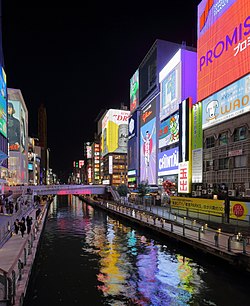
What you came to see is above the street. Giant three-dimensional signs, a crab, a squid, an octopus, even a cow, hang overhead, so a baby in your arms can look up at them. The Glico sign leaning over the Dotonbori canal is 20.00 m high and 10.38 m wide, built from about 140,000 LED chips, and lights from sunset until midnight. Ebisubashi bridge has a ramp built into its design, so a stroller rolls down to the riverside walk one level below (Tombori River Walk).There is no public nursing room and no diaper changing table inside Dotonbori (it is not among the 464 "Baby Stations" Osaka City listed as of 15 July 2026). The nearest are Namba Station on the Subway Midosuji Line (nursing and diaper change, 5:00-24:00 daily; speak to staff at the stationmaster's office) and Shinsaibashi BIGSTEP (nursing and diaper change, 11:00-20:00, with a formula-water dispenser). The riverside walk has no toilet either, so go before you head down.

A baby who falls asleep does not have to be lifted out. Visitors using a stroller as a wheelchair are given an identification tag, the Stroller Tag, which gets them the same handling as a wheelchair at attractions and in show viewing areas; it is handed out at two places in the park and at each attraction entrance. Rental strollers start from one month old, and admission is free for children 3 and under. While an older sibling rides, Child Switch lets the two adults take turns on a single wait (20 attractions)."Family Services" for nursing, formula, and baby food are at three places in the park: beside Guest Services, inside Universal Wonderland, and in the San Francisco area beside South First Aid. Hot water for formula and a microwave for baby food are available (there is no microwave at the South First Aid location). Diaper changing tables are in every restroom in the park except those inside restaurants, in both the men's and the women's, and used diapers can be thrown away there. Everyone passes a metal detector and X-ray security check before entry, so everything in the stroller basket comes out into the tray. With anything other than an annual pass there is no re-entry, so a nap in the car is not an option. Rental strollers are 1,100 yen each and cannot be reserved.

Children under 4 enter free. Floors 39 and 40 are indoors, and the indoor observation floor on 40 holds cafe SKY 40 with its long glass counter, so you can sit with the baby in your arms and look out. There is also a side of this place you can enjoy without going up at all: the ground level, Shin-Umeda City, is free to walk — the Middle Nature Forest with its waterfall and stream, the roughly 8,000-square-meter Flower Field and New Satoyama, and Wonder Square, the open atrium between the two towers.The entrance is not inside the building. You cannot get in from the Tower East or Tower West elevators; you enter through an outdoor door on the Wonder Square side, marked FUN FUN PLAZA. With a stroller, skip the see-through escalator — which the operator itself calls very narrow and steep — and take the high-rise elevator from the 1st floor of Tower East up to floor 39. The English and Chinese versions of the FAQ go further, with a diagram: follow the green arrow route and pick up the white phone on the counter, and staff will come. The two nursing rooms are on floors 39 and 40, both inside the observatory, past the ticket counter, and there is no re-entry. No official page mentions a diaper changing table anywhere.

Admission is free at any age, and the whole museum is indoors across two floors. On the 1st floor, the Instant Ramen Tunnel is a passage where about 800 kinds of packages hang over your head, so a baby in your arms can look up at them. You tour at your own pace and can re-enter, so you can step out and come back when the baby needs it.There is one nursing room, on the 1st floor just before the restroom near the entrance hall (next to the wheelchair-accessible toilet). There is one baby bed for diaper changes, and you ask at the Information counter where the baby facilities are. There is no hot water for formula in the museum: the Tasting Room that had the hot-water facility is suspended for the time being. No strollers are lent and there are no coin lockers inside, so leave big bags in the large lockers outside the ticket gates at Hankyu Ikeda Station before you walk over.

The 4th floor, the "Asobou (Play) Floor," is the one the museum itself lists as recommended for babies and toddlers. On the 1st floor, the Ball Circus is an exhibit you simply watch, with balls rolling along rails and riding a Ferris wheel, so a baby in arms can follow it with their eyes. Everything is indoors, so heat, cold, and rain do not change the plan.Admission is free for ages 0 to 2. Strollers are lent free at the 1st-floor information desk (20 of them, for use inside only), and the maker's rules limit them to children up to age 2. The nursing room is inside Peekaboo on the 4th floor, with a hot-water dispenser for formula and a sink nearby. Diaper changes happen on the baby sheets in the multipurpose restrooms on every floor, and vending machines on the 4th and 5th floors sell diapers. For the children's safety there is no microwave and no hot-water pot in the building, so bring baby food that can be eaten unheated.

The main paths are paved, so the full loop, about an hour, can be walked with a stroller. Strollers are lent free at the main gate or at the ticket gate of the Information Center on Flowers, Greenery and Nature. Life Garden is a field of flowers end to end, and benches around the big pond and on the lawn let you stop and rest along the way.The nursing room is at the back of the Green Consultation Room inside the Information Center on Flowers, Greenery and Nature, with two private nursing booths and two diaper changing tables, and you can wheel a stroller in. Men, family included, may not enter, so a father changing a diaper uses the baby beds by the washbasins in the 1st- and 2nd-floor restrooms of the Information Center (both men's and women's). The nursing room follows the Information Center's hours (March to October 9:30-17:00, November to February 9:30-16:30). Loaner strollers go first come, first served on the day, with no reservations. There are no bins except at the garden entrance and north of the lawn, so bring a bag to carry your rubbish out.

All 38 seats are tables, and the whole restaurant is non-smoking, so you can sit at the family table with the baby in your arms. The shop welcomes children, and a review posted in January 2026 records a visit made "with family and children".The restaurant takes no reservations, online or otherwise. When it is busy you may be asked to share a table. Payment is cash only: no credit cards or electronic payments. There is no parking; it is a 2-minute walk from exit 11 of Kintetsu Namba Station and the subway Namba stations. Open 11:00-20:00 (last order 19:45), closed Mondays, or the following day when Monday is a public holiday.

Up in a carrier, a baby rides at your eye level, close enough to watch the fish and fruit go past. The street is loud enough that whatever noise the baby makes disappears into it.If the stroller is coming anyway, choose a weekday. Year-end draws about eight times the weekday crowd, so that is the one time of year to leave it behind.

Crowds and heat wear a baby out before the shopping does, and one family with a six-month-old started in the morning and was gone by three. Pauses happen next door: the baby room in Daimaru has nursing booths, a changing bed and a baby-food corner where you sit facing your child to feed them, and it was near empty when one family stopped there after lunch.

拝む場所からお不動さんまでは距離があり、水を掛けるのは大人の役目になります。全身が苔をかぶった姿は大人でもびっくりするほどで、抱っこのまま見上げるだけでも目にとまる眺めです。

With a baby, the day is harder but still works: a couple with a 1-year-old and a 4-year-old found the trip tough going yet fun. One kushikatsu restaurant, Kushiemon, was roomy enough for them to wheel the stroller in.

Under 2, big animals close by land best: giraffes drew the biggest reaction from a 1-year-old, who seemed barely to notice darker animals, while on a 2010 visit after lunch, a 10-month-old missed animals that were far away. Even so, on a quiet April weekday, a 1-year-old could see the lions and giraffes easily from a stroller, though on crowded days animals can be hard to see from one.