Osaka with a toddler (2–3) 15 spots
Osaka is Japan's eating city, home to Tenjinbashisuji — the country's longest shopping street, 2.6 km and about 800 shops under one continuous roof. You can graze your way along it with a stroller even on rainy days. It suits kids who won't sit through meals and families who travel to eat.
Kansai's gateway on an artificial island, about 40 minutes to Namba and 80 to Kyoto.
Stroller OK · Nursing room · Changing table · checked Aug ’26
An aquarium arranged by region around the Pacific Rim, holding some 620 species.
Stroller OK · Nursing room · Changing table · checked Aug ’26
A castle keep rebuilt in 1931 by public donation, holding an eight-floor museum inside.
Stroller OK · Nursing room · Changing table · checked Aug ’26
An entertainment street along a canal finished in 1615 and named for its digger.
Stroller OK · checked Aug ’26
A film theme park on Osaka Bay, its ten areas including Mario and Harry Potter worlds.
Stroller OK · Nursing room · Changing table · checked Aug ’26
Umeda Sky Building (Kuchu Teien Observatory)
Two Osaka skyscrapers joined at the top by an open rooftop deck, 173 meters up.
Stroller OK · Nursing room · Elevator · checked Aug ’26
In Ikeda, where instant noodles were invented in 1958.
Stroller OK · Nursing room · Changing table · checked Aug ’26
A children's museum built to be touched, the first of its kind in Japan.
Stroller OK · Nursing room · Changing table · checked Aug ’26
Osaka Municipal Nagai Botanical Garden
Roses, hydrangeas, peonies: eleven collections in a botanical garden inside Nagai Park.
Stroller OK · Nursing room · Changing table · checked Aug ’26
Pufferfish and fruit out front, shop after shop, down one straight street.
Changing table · checked Sep ’26
SHINSAIBASHI-SUJI SHOPPING STREET
A covered shopping arcade 580 meters long, running north from Dotonbori to Nagahori-dori.
checked Oct ’26
Hozenji Yokocho is two stone-paved lanes lined with about 60 restaurants, beside a small temple.
checked Sep ’26
Shinsekai is Osaka's retro entertainment district, born in 1912 with the first Tsutenkaku observation tower.
checked Oct ’26
Tennoji Zoo is a zoo in central Osaka, open since 1915 and among Japan's oldest.
Stroller OK · Nursing room · Changing table · checked Oct ’26

The kids' playing areas are colorful corners for children up to 6 with a parent — the place to burn the pre-boarding energy, rather than at the gate.Terminal 1 is a long building. If your gate is far, take the free loaner stroller even for what you think is a short walk (Terminal 1 second-floor information counter, Terminal 2 domestic information counter; airline counters often lend one too, so ask at check-in). The free shuttle between Terminals 1 and 2 takes 7 to 9 minutes. The airport limousine buses into the cities give everyone a seat and involve no stairs.

The route starts on 8F in the Japan Forest, with the sound of a waterfall and green moss. Then penguins in Antarctica, Pacific white-sided dolphins in the Tasman Sea, a huge shoal of sardines on the Chilean rocky shore, and at the end, jellyfish drifting in Jellyfish Galaxy on 3F. From 3F up to the ringed seal tank on 4F, you ride the elevator yourselves.There are no dolphin or sea lion shows, and the aquarium explains why: it wants the animals watched in something close to their natural state. Staff do not page over a PA system, and lost children are handled at the information desk beside the ticket windows. Eating in the viewing corridors is not allowed; the one place to eat is cafe R.O.F on 4F. What you may carry in is drinks in lidded containers that will not spill if knocked over, and baby food.

On 7F, Karakuri Taikoki is a diorama of 19 scenes, one to two minutes each, in which a tiny Hideyoshi moves about inside the miniature sets. On 5F, the World of the Summer Battle of Osaka Screen recreates the clash between Sanada Yukimura's and Matsudaira Tadanao's forces with miniature figures. The official park map marks a playground with play equipment on the Morinomiya side.There is only one restroom inside the keep, on 2F, the same floor as the first-aid room and the office. The keep is a museum, so eating and drinking inside are not allowed; only benches for resting are provided. Eat on the park side: cafes at JO-TERRACE OSAKA, MIRAIZA OSAKA-JO and the Morinomiya fountain area, a convenience store with seating at the Babacho front entrance, and three free water points. The castle itself notes that the viewing space narrows on the upper floors and gets very crowded.
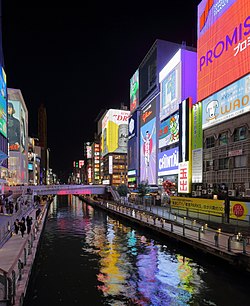
The street is lined with figures. There is Kuidaore Taro, ringing his bell and beating his drum, and the skewer-shop old man growling "no double-dipping." The Dotonbori merchants' association writes that they "greet you with every kind of expression: Dotonbori is like a theme park of figures." Nothing to queue for. You find them and take the picture.Ebisubashi is where the crowd jams. Osaka City writes that "jumping up and down on the bridge obstructs safe passage and is extremely dangerous." The city also forbids jumping into the Dotonbori canal: the water by Ebisubashi is about 3.5 m deep and heavily used by boats. No official page names a place to report a lost child in this district. In summer the evening events run one after another (the Dotonbori River Mantosai from 1 July, 2,100 lanterns), so with a stroller the daytime is the safer half.

Five attractions open up at 92 cm: Yoshi's Adventure, Flight of the Hippogriff (92-195 cm), Minion Hachamecha Ice, Snoopy's Great Race, and Flying Snoopy. Four more have no height limit at all (Minion Hachamecha Mission, Hello Kitty's Cupcake Dream, Jaws, and the Detective Conan 4-D Live Show). In Universal Wonderland, the children's area, the play building Snoopy Studio, recommended for 12 and under with no height limit, is one the park itself describes as somewhere you can "play your heart out even on a rainy day"; and for designated attractions the free "Yoyakunori" lets you fix a ride time instead of queuing.A child under 122 cm needs a companion, and the park defines the companion too: "someone in junior high school or above, in sound mental and physical health, who meets the ride's own criteria." An older sibling in elementary school does not count. Phones, umbrellas, keys, and other small items are banned on nearly every attraction, so the stroller does not come to the boarding area. Decide in advance where it waits and who watches the child while it does. Food brought from outside may not be eaten in the park, but the official line is: "for baby food and snacks for small children, please consult a crew member." The Lost Child Center is on the left of the entrance, inside the park, for children of elementary school age and under.

Children under 4 enter free. The menu at cafe SKY 40, on the indoor observation floor, is not just coffee: takoyaki from 600 yen, omurice 700 yen, hot dogs from 600 yen, chicken nuggets 400 yen, sundaes 600 yen — food that counts as a meal. There are official Gashapon capsule-toy shops in two places: on floor 40, and on the 3rd floor of Tower East before you go up.The rooftop is open air with no roof, and umbrellas may not be used there for safety; raincoats are sold at the gallery shop on floor 39. Rain alone does not close it, but in severe weather the rooftop alone may be shut while floors 39 and 40, which are indoors, stay open. There is no re-entry, so feed the baby and use the restroom before you go up. The operator asks you to refrain from bringing food and drink onto the rooftop. Bags cannot be checked inside the observatory; the coin lockers are in three places — Garden 5 on the 1st floor, Takimi-koji on B1, and the parking level on B2.

On the 1st floor, "Momofuku Ando and the Story of Instant Ramen" is a hands-on display; the museum writes that children turn handles on the wall and open doors, so even small children enjoy looking around. My CUPNOODLES Factory on the same floor has no age limit, so a child draws on their own cup, and an accompanying adult helps with the parts that are too hard.My CUPNOODLES Factory costs 500 yen per cup and needs a numbered ticket, handed out first-come after you enter (they stop once the day's tickets are gone; last reception 15:30; allow about 45 minutes). When it is busy it is one cup per person. If someone in the family joins the Chicken Ramen Factory on the 2nd floor, preschoolers cannot enter that room, so one adult stays outside with them and watches through the glass. There is currently nowhere to sit and eat inside, and food and drink cannot be brought in, so plan meals before you arrive or after you leave.

Kids' Town, the climbing city that runs through the 4th and 5th floors, has a rope bridge and a tube slide to run around in. The 4th floor, the "Asobou (Play) Floor," is built around Kids' Town and zooms in on everyday life for children to act out. The exhibits are hands-on, made to be touched and climbed, and staff called interpreters introduce them and draw children in.Ages 3 to 5 pay 500 yen (0 to 2 are free). The tube slider runs 10:00-14:00 on weekdays, so on a weekday get in before 14:00 and let them slide first. The loaner strollers only go to children up to age 2 (about 15 kg), so bring your own if your child is 3. Wash-off showers for accidents are in the 5th-floor restroom (culture corner) and the 4th-floor restroom (Peekaboo). Children cannot enter on their own; a guardian must come with them.

You can eat a packed lunch anywhere inside the garden, and the benches around the big pond and on the lawn are free to use. Nagai's Satoyama and Satoyama Plaza is a new patch of countryside made in the city. Pick up the bloom map handed out at the entrance and walk around hunting for whatever is at its best today. Admission is free through junior high school.Collecting plants is not allowed, fallen leaves, seeds, and acorns included, and neither is collecting insects. Instead of picking things up to take home, turn it into a hunt with the bloom map. Ball games are not allowed inside the garden, and the water features, streams, and ponds are off limits to enter. Some of the specialty gardens (Azalea Hill, the Rhododendron Garden, the Hydrangea Garden and others) have steep slopes and unpaved stretches, so keep a stroller on the main paved loop. Three arbors around the garden give shelter from rain.

Beyond the famous curry the menu has omurice, chicken rice, hayashi rice, lunch sets and set meals, so there is something to pick for a child. Seating is tables only, so the family sits around one on chairs.There are no reservations, and when it is busy you may be asked to share a table. There are no private rooms and no tatami seating; all 38 seats are at tables. Payment is cash only, and the whole restaurant is non-smoking. Open 11:00-20:00 (last order 19:45), closed Mondays. There is no parking; it is a 2-minute walk from exit 11 at Namba Station.

The shops change as you walk: fresh fish, then fruit, then something to eat. At this age that is the point, something new to stop in front of every few steps.End to end and back is three-quarters of a mile (1.2 km), so count on carrying them part of the way back. Two hours is the outside length of most visits, so the carrying only has to last that long.

Distance decides the day at this age, and walking the whole street shop by shop takes half a day, so pick one stretch rather than the full length. Daimaru also lends strollers for children aged three and under, from the information desk on the first floor of its main building.

This is the age that copies the ritual, so expect hands in the water. The purification basin comes first — a toddler here rinsed her hands the way the adults did, then took her turn at the statue.

Small children do best with the simplest games: in a 2019 article, the games near the entrance of the Kasuga Gorakujo game hall were plenty for a 3-year-old, while those further in suited school-age children. On Tsutenkaku's observation deck, the lucky Billiken statue, whose soles people rub, sits high, so lift little ones up to reach.

At 2 or 3, a short, happy visit can beat seeing everything: a 2-year-9-month-old barely used the stroller, ran around and left after about 90 minutes still in a good mood. That same child found the giraffes too big up close and calmed down a little farther back.