Osaka with preschoolers (4–6) 13 spots
Osaka is Japan's eating city, home to Tenjinbashisuji — the country's longest shopping street, 2.6 km and about 800 shops under one continuous roof. You can graze your way along it with a stroller even on rainy days. It suits kids who won't sit through meals and families who travel to eat.
Kansai's gateway on an artificial island, about 40 minutes to Namba and 80 to Kyoto.
Stroller OK · Nursing room · Changing table · checked Aug ’26
An aquarium arranged by region around the Pacific Rim, holding some 620 species.
Stroller OK · Nursing room · Changing table · checked Aug ’26
A castle keep rebuilt in 1931 by public donation, holding an eight-floor museum inside.
Stroller OK · Nursing room · Changing table · checked Aug ’26
An entertainment street along a canal finished in 1615 and named for its digger.
Stroller OK · checked Aug ’26
A film theme park on Osaka Bay, its ten areas including Mario and Harry Potter worlds.
Stroller OK · Nursing room · Changing table · checked Aug ’26
Umeda Sky Building (Kuchu Teien Observatory)
Two Osaka skyscrapers joined at the top by an open rooftop deck, 173 meters up.
Stroller OK · Nursing room · Elevator · checked Aug ’26
In Ikeda, where instant noodles were invented in 1958.
Stroller OK · Nursing room · Changing table · checked Aug ’26
A children's museum built to be touched, the first of its kind in Japan.
Stroller OK · Nursing room · Changing table · checked Aug ’26
Osaka Municipal Nagai Botanical Garden
Roses, hydrangeas, peonies: eleven collections in a botanical garden inside Nagai Park.
Stroller OK · Nursing room · Changing table · checked Aug ’26
Pufferfish and fruit out front, shop after shop, down one straight street.
Changing table · checked Sep ’26
Hozenji Yokocho is two stone-paved lanes lined with about 60 restaurants, beside a small temple.
checked Sep ’26
Shinsekai is Osaka's retro entertainment district, born in 1912 with the first Tsutenkaku observation tower.
checked Oct ’26

The kids' playing areas take children up to 6 years old, so this age can still play there with a parent. The airport itself stands on its own artificial island in Osaka Bay, and Terminal 1 was designed by Renzo Piano.Terminal 2 is the simplified low-cost building used by Peach, Spring Airlines and Jeju Air, and it has no jet bridges. The free shuttle between Terminals 1 and 2 takes 7 to 9 minutes. To Tennoji, the JR Haruka limited express takes about 30 minutes and the Kansai Airport Rapid about 45; to Shin-Osaka the Rapid takes about 65 minutes. The Nankai line runs to Namba, the limousine bus to Osaka Station (Hankyu Sanbangai) takes about 60 minutes, and the direct bus to Kobe Sannomiya about 1 hour 5 minutes.

With the Kaiyukan Expedition Stamp Note (400 yen) in hand, a child matches a silhouette to the right creature and presses all 11 stamps hidden around the aquarium themselves. The aquarium says the notebook works for preschoolers too. Each tank's name board hides the creatures that live in that tank. On 4F, a real piece of the Pacific Ocean tank's acrylic panel, up to 30 cm thick, is on display.The stamp notebook is sold at the official shop on Entrance Building 3F, before the entry gate. The children's toilet is likewise before the gate, inside the Baby Care Room on Entrance Building 2F. Since there is no re-entry, stop at both on the way in. Most visitors take about two hours to go round. Buying at the window on the day can mean a long wait, so the aquarium recommends buying a timed Kaiyukan e-ticket in advance.

On 2F, the helmet and surcoat try-on corner lets a child put on a reproduction warlord's helmet and jinbaori and be photographed with your own camera (500 yen per person per turn). A commemorative stamp sits on the same floor. The observation deck on 8F is 50 meters up. Two minutes' walk from the keep, the Toyotomi Ishigaki Museum takes you underground to Hideyoshi's stone wall, which the Tokugawa buried under fill; your keep ticket admits you.The elevator inside goes up only, for everyone, and runs only as far as 5F. From 5F to 8F, and all the way down from 8F to 1F, you take the stairs. (6F is a closed corridor with no exhibits.) Junior-high age and under enter free, but proof is required, such as a passport for under-15s from abroad. It is a 15-to-20-minute walk from the stations, and the castle recommends Tanimachi 4-chome: about 1.1 km to Sakura-mon with about 10 m of climb. Open 9:00-18:00 with last admission 17:30, and the ticket queue may be closed off earlier than 17:30 depending on conditions.
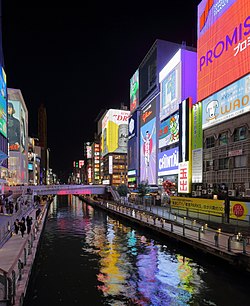
They can get on a boat and pass under nine bridges. The Tombori River Cruise runs about 20 minutes, departing on the hour and the half hour from the 11:00 to the 21:00 sailing. The pier is Tazaemonbashi, and the operator says to "look for the oval yellow Ferris wheel (Don Quijote Dotonbori) as your landmark." The merchants' association tells visitors that the Dotonbori canal is "the place where Issun-boshi, the One-Inch Boy, is said to have set off in his rice bowl."The boat is open-topped, with no roof. It "sails in light rain," but umbrellas are refused as dangerous, since they "can jab other passengers or catch on the low bridges," and in rain you are handed a simple raincoat (which the operator notes may not cover your bags). Sailings can be cancelled for weather, sea conditions, or tide. On fares: for children below elementary school age, one rides free per adult, and from the second child on the "child" fare applies (500 yen, the elementary school rate).

One step up the height ladder and the park grows: at 102 cm they can ride Minion Hachamecha Ride and Space Fantasy the Ride; at 107 cm, Mario Kart ~Koopa's Challenge~, Donkey Kong's Crazy Trolley, and Jurassic Park the Ride. A child turning 4 gets the "4-Year-Old Birthday Invitation Pass" free, through free Club Universal membership. Meals are published down to the shop name: 15 restaurants will warm food, 10 will heat it in a water bath, 19 provide hot water, and Snoopy's Backlot Cafe has "tables and chairs sized for children."Some rides still stay out of reach: Harry Potter and the Forbidden Journey needs 122 cm, and Hollywood Dream the Ride (forward and Backdrop) and The Flying Dinosaur need 132 cm. That is what Child Switch is for, one wait and the accompanying adults ride in turn (20 attractions; ask a crew member how it works). Under 122 cm, a companion is still required. For Halloween Horror Night in autumn, 11 September to 8 November in 2026, the park draws its own age line, "not recommended for children 5 and under" and "children 12 and under need a guardian's consent," and the official event map marks Safety Areas and Safety Routes to walk instead. Measure your child before you go and the day argues less.

Sky Quest, sold at the reception counter on floor 39, is a kit for exploring the site while answering quizzes and drawing: a booklet, a clear file and a marker pen, 700 yen, admission not included. Show the booklet at cafe SKY 40 on floor 40 and you get a cup of soft-serve ice cream; answer all the quizzes and show it back at floor 39 and you get a prize as well — wrong answers still count. On the rooftop, the operator names what you can see in each direction: north, planes taking off and landing at Itami Airport and the Yodo River; south, the Kaiyukan aquarium, the Tempozan Ferris wheel and Universal Studios Japan; east, the keep of Osaka Castle.Admission is 500 yen for ages 4 through elementary school and 2,000 yen for adults (junior high and up). The Sky Quest booklet is sold only at the reception counter on floor 39, not online, and costs 700 yen on top of admission. The entrance is not inside the building; you come in through the outdoor door on the Wonder Square side, and the tower elevators will not take you to the observatory. The rooftop is open air with no roof, so dress for wind and temperature. There is no re-entry: once you come down, the visit is over.

At My CUPNOODLES Factory a child does six of the eight steps themselves: buy the cup from a vending machine, clean their hands, design the cup, set the noodles in, choose a soup from four kinds and four toppings from twelve, and finally pump air into the packaging bag. Staff do only two steps, the lid and the shrink wrap. There are 5,460 flavour combinations in all.Same numbered ticket, 500 yen per cup, last reception 15:30. Allergens are published ingredient by ingredient so you can choose around them, but peanut is in the curry soup and the museum states that a soup using peanut is served at the same counter. Eat the cup noodles you make within a month of making them. The Chicken Ramen Factory on the 2nd floor is for elementary-school age and up (1st to 3rd graders pair up with someone junior-high age or older), so before school age the hands-on making is My CUPNOODLES Factory on the 1st floor.

The 3rd floor, the "Tsukurou (Make) Floor," is lined with programs about the joy of making things, and workshops in crafts and experiments run here too. The 5th floor, the "Yattemiru (Try) Floor," gathers corners where science and culture are learned through play. Around 250 interpreters, volunteers included, will explain an exhibit if your child asks.Ages 3 to 5 pay 500 yen and ages 6 to 15 pay 800 yen; a 6-year-old still pays the 500-yen preschool rate until the end of March of the year they graduate from kindergarten. Workshop fees and the museum shop take cash only, so carry some. On weekdays in school excursion season (late April to late June, late September to early December, February to mid-March) it is crowded from 9:30 to 14:30, and after 14:30 on weekdays it is comparatively relaxed.

Eleven specialty gardens, roses, hydrangeas, peonies and more, and in the Forest of History you meet the plants that have grown in Osaka since 66 million years ago. Give your child the bloom map from the entrance and let them lead the hunt for what is in season. On 25 December 2025 a reading corner built from the park's own trees opened. The Information Center on Flowers, Greenery and Nature is free to enter, and specialists at the Green Consultation Corner on the 1st floor answer questions.Admission is free through junior high school; adults pay 300 yen. One loop of the garden takes about an hour, and it is roughly 800 meters east of Exit 3 at Nagai Station on the Osaka Metro Midosuji Line. From Nagai subway station and the Nagai Park South car park you can reach the Information Center and the garden with no steps. Group excursions crowd the place on weekdays from mid-April to mid-June and in October and November, especially in the morning, when kindergarten, nursery, and school groups arrive from opening time.

This is the restaurant that opened in 1910 as Osaka's first Western-style restaurant, and the famous curry was born here; skilled cooks still make it in this Namba kitchen and it is carried out to the other shops every day. After the meal a child can pick a souvenir, including a retort pouch of the famous curry to eat at home.The restaurant takes no reservations, so you go and wait your turn, and when it is busy you may be asked to share a table. Payment is cash only: no cards or electronic payments. The Namba main shop revised its prices on 14 July 2026, and the shop itself notes that prices and menu items shown on the menu page may change slightly. Open 11:00-20:00 (last order 19:45), closed Mondays.

This is the age that stops in front of a shop to ask what a pufferfish is. The fish laid out here are not the ones a child sees at home. It is also the first age that can walk the whole street and back without being carried.They will get ahead of you, and there are enough people to lose sight of them. There are no side streets to turn down, but pick a shop to meet at before you start.

柄杓を両手で持てる歳になると、水を掛ける役をまかせられます。ただし拝む場所からは距離があるので、狙った所へ届かせるには力が要ります。2025年5月には線香が一束50円で、買って供えるところまで手が届きます。

For 4- to 6-year-olds, the bustle itself is the show: a 4-year-old who skipped the observation deck was overwhelmed by the kushikatsu signs, Billiken and the lively streets, yet clearly enjoyed them. At a super-ball scooping stall, another child of about 4 caught none, but the stall keeper let him take three home.